As an Amazon Associate we earn from qualifying purchases. Some brands also pay us when you click or buy, so those links are ads. Full disclosure below
A hula hoe, also sold as a stirrup, scuffle, action, loop or oscillating hoe, is a long-handled weeder with an open steel loop that slices weeds just under the soil on both the push and the pull. It is the fastest tool for clearing small weeds from a large, loose bed, and the wrong tool for established weeds, crusted clay, and tight rows.
One thing first: we make the Spear Head Hoe, a draw hoe, not a stirrup hoe, so none of the picks below are ours. Where a draw hoe does the job better we say so, and where the stirrup wins we say that too.
What is a hula hoe (stirrup hoe)?
A stirrup hoe is a weeding hoe whose blade is a thin steel loop shaped like a riding stirrup, set on a long handle. Instead of chopping, the loop skims a quarter to a half inch below the surface and severs weed roots as you push and pull it, disturbing the soil so little that few buried seeds are woken.
Hula, stirrup, scuffle, action, loop, oscillating: same tool?
Yes, with one exception. Every one of those names describes an open steel loop on a long handle that cuts on the push and the pull, and the only real split is whether the loop is rigid or hinged. The exception is the UK, where a scuffle hoe usually means a flat Dutch hoe. The UC Statewide IPM Program's WeedCUT guide to scuffle hoes says the stirrup hoe is "also called an oscillating hoe, a scuffle hoe, a hoop hoe, or a swivel hoe" and names the Hula Hoe as one common brand.
It is one tool with many names. Hula hoe comes from the Hula-Ho, the Flexrake model that made the design popular. Scuffle hoe is the usual American name, though in the UK it means a Dutch push hoe, a different tool. Oscillating hoe and action hoe describe the hinged version, where the loop rocks a few degrees on a pivot. Hoop hoe and loop hoe are plainer names for the same loop. Our garden hoe types guide maps the whole hoe family; draw hoes, which you pull, are the other half of this guide.
How does a stirrup hoe work?
A stirrup hoe cuts in both directions. The front edge of the loop slices forward on the push and the back edge slices toward you on the pull, about a half inch down, severing weed roots below the crown. Hinged models tilt the loop a few degrees each way so it meets the soil at a cutting angle every stroke.
Three things make it work. The loop is open, so soil passes through instead of piling up in front of the blade. Both edges are sharpened, so every return stroke cuts. And the blade runs shallow, in the top inch where seedlings live, leaving the dormant seed bank below undisturbed. The same design sets the limits: a skimming loop cannot chop through a taproot, it skates across crusted clay or hardpan instead of cutting under it, and a loop four to seven inches wide is no precision tool next to a lettuce stem.
When a stirrup hoe beats a draw hoe, and when it does not
A stirrup hoe wins the weekly pass over a big, loose bed and on small weeds with thread roots. A draw hoe wins on established weeds and taproots, on crusted clay or hardpan, in tight rows near stems, and for every furrowing, hilling, or seedbed job.
| The job | Stirrup hoe | Draw hoe |
|---|---|---|
| Weekly pass over a big, open, loose bed | Wins. Faster than any pulled blade | Works, but slower |
| Weeds under two inches with thread roots | Wins. Severs dozens a minute | Works |
| Established weeds, taproots, grass clumps | Loses. Rides over or snags | Wins. Chops the crown, lifts the root |
| Crusted clay or hardpan after rain or drought | Loses. Skates on the crust | Wins. Breaks the crust, then levels it |
| Tight rows, close to plant stems | Loses. Too wide to control | Wins. A short, controlled pull |
| Furrows, hilling, cultivating a seedbed | Cannot. It only weeds | Wins. Built for it |
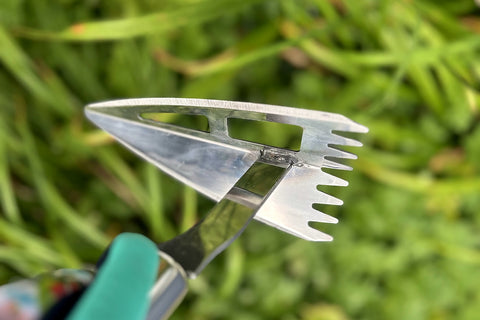
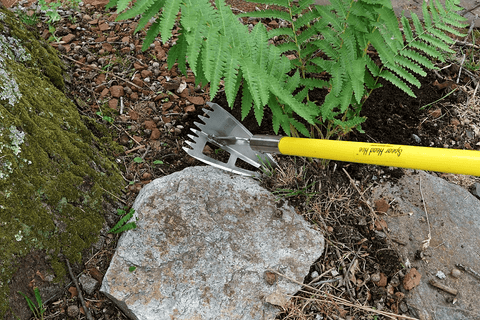
That is why the two are partners, not rivals. The stirrup hoe owns the weekly pass over open ground; the draw hoe owns everything the stirrup cannot do. For that half of the list, the draw hoe we make, the Spear Head Hoe, is a weeding, cultivating, and furrowing hoe built for exactly that work: a stainless steel, pre-sharpened blade that cuts weeds cleanly instead of tearing them, a rake on the back of the head for breaking clods and leveling the bed, a 60 inch fiberglass handle that keeps you standing upright, and two cushioned grips. It sells on Amazon. Our best garden hoe guide ranks the draw hoes, and the best weeding tools guide covers pullers, hand weeders, and lawn tools.
How to use a hula hoe (stirrup hoe)
Use a stirrup hoe on a dry day, on weeds under two inches tall. Stand upright, hold the handle like a broom, set the loop no more than a half inch deep, and push and pull it in short strokes driven from your hips, walking backward down the bed and keeping a hand's width from crop stems.
1. Pick a dry day and catch the weeds small
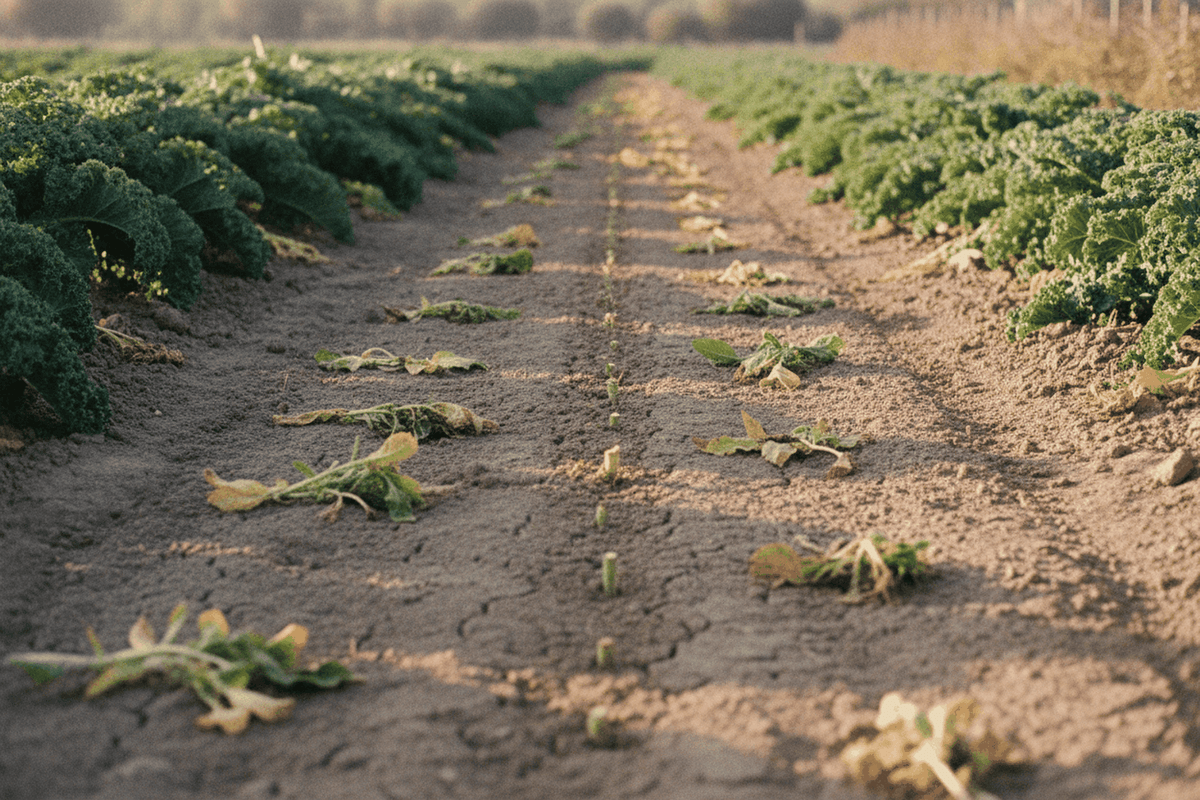
Weed on a dry morning, a day or two after rain. Cut weeds wither on dry soil within hours; on wet soil they re-root. The tool is at its best on seedlings under two inches tall.
2. Set your grip and your stance
Hold the handle like a broom, one hand near the end and the other a forearm's length down, thumbs toward the blade. Stand upright, feet a little wider than your shoulders.
3. Set the blade just under the surface
Rest the loop on the soil and press it in a quarter to a half inch. If soil is rolling over the loop, you are too deep, and every extra half inch wakes a fresh crop of weed seeds.
4. Push and pull in short strokes
Work the hoe back and forth in strokes twelve to eighteen inches long, driven from your hips more than your arms, and let the edge cut on both the push and the pull. With a rigid loop, tilt the handle slightly so the leading edge bites.
5. Work backward down the bed
Start at one end and walk backward, so you never step on ground you have just weeded or bury weeds you have just cut. In a row garden, run the loop between the rows, then between plants where the spacing allows.
6. Keep a hand's width away from stems
The loop sweeps, so keep it a hand's width from crop stems and shallow-rooted plants like onions. Finish that last strip with a hand weeder or a narrow draw hoe.
7. Leave the weeds where they fall, and come back in a week
Do not rake up seedlings cut on a dry day; the sun finishes them and they become mulch. A weekly pass takes minutes and stops weeds before they outgrow the tool.
Where a hula hoe fails
A hula hoe fails on any weed that grows back from below the cut. The UC Statewide IPM Program's WeedCUT guide to scuffle hoes says the method "is not very effective on species that grow from underground storage structures, such as bulbs, rhizomes or tubers, or plants that are woody or re-sprout from nodes or plant fragments." Six places to put it down:
- Perennial roots, bulbs, rhizomes and tubers. The loop takes the top off and the root sends up a new one. UC IPM's weed management guide for landscapes adds that perennial weeds "are often spread by cultivation and should be controlled or removed by other methods." Dig those out by the root; our guide to the best hori hori knife covers the tool for taprooted weeds.
- Weeds that got big. WeedCUT says stirrup hoes "do not work well on large annuals", and that as weeds grow, "the stems and roots become tough to sever." Catch them under two inches.
- Wet soil, or rain right after. Cut weeds can "re-root into the soil and may not die, especially if it rains shortly after a treatment or in wet soils," per WeedCUT. Hoe on a dry day.
- Going deeper than the top inch. UC IPM's landscape guide says to avoid deep tilling, "as this brings buried weed seeds to the soil surface where they are more likely to germinate." Keep the loop a quarter to a half inch down.
- Hard or stony ground. WeedCUT says the rounded hoop style "can only be used in soils that are easy to work," and that blades need regular sharpening "especially in soils with small rocks." On crusted clay the loop skates instead of cutting.
- Beds with drip line. The Market Gardener warns that the sharp blade "can easily cut into the drip tape." For perennial beds, UC IPM's landscape guide says to use geotextiles where possible; our weed barrier and landscape fabric guide compares them.
When you need a draw hoe instead
Two of those failures are draw hoe work: weeds that got big, and crusted ground. A blade you pull toward you chops through a tough stem, breaks a crust, and makes a short, controlled stroke beside a plant, while perennial roots still come out by hand. We make the draw hoe, not a hula hoe. The Spear Head Hoe has a stainless steel head with two sharpened side edges and an 8-tine rake on the back, on a 60 inch handle, so you can weed, cultivate and furrow standing upright.
How to sharpen and maintain a stirrup hoe
A stirrup hoe stops gliding the moment either edge dulls.
- File both edges. Clamp the head and run a flat mill file along the existing bevel of the front edge, pushing away from you, five or six strokes, then do the back edge. Even a loop sold as self-sharpening benefits from a few strokes each spring. Wear gloves.
- Clear the pivot on hinged models. Packed soil makes an oscillating loop stiff. Knock the head clean after each use and snug the bolt if the loop wobbles more than it should.
- Check the head-to-handle connection. Once a season, tighten the bolts through the ferrule or tang and replace a loose rivet before the head starts to twist.
- Oil the handle, replace the loop, store it dry. Wipe boiled linseed oil onto a wood handle each fall. The loop thins over years of filing, and some brands sell replacement blades. Hang the hoe blade-up; most stirrup blades rust in a damp corner.
Hula hoe blade widths, matched to row spacing
Choose the loop width to fit the gap you weed most. The Market Gardener explains the reason for the 3¼, 5 and 7 inch sizes grower suppliers sell: with the right width you get "as close as possible to the plants without touching them." Narrow loops go between plants and in beds planted with more rows; wider loops suit beds planted with fewer.
| Blade width | Where it fits | Sold as |
|---|---|---|
| 3¼ inch | Tight spaces between crop plants, and beds planted four or five rows across | Johnny's Selected Seeds stirrup hoe (not one of our picks) |
| 5 inch | Between the garden rows | Johnny's Selected Seeds stirrup hoe (not one of our picks) |
| 6 inch | Between the 5 and 7 inch jobs; its listing names weeding and edging | Hoss Stirrup Hoe (pick 2) |
| 7 inch | Beds planted three rows across (the larger blade The Market Gardener recommends) | Edward Tools Double Action Stirrup Hoe (pick 4); Johnny's also sells a 7 inch |
The 3¼, 5 and 7 inch guidance comes from The Market Gardener (a larger blade for three-row crops, a smaller one for four or five rows) and Easy Digging (a 5 inch blade between garden rows, a 3 inch blade for tight spaces between plants); the 6 inch row is the Hoss listing's own description. The Flexrake and Ames listings do not state a loop width, so they are not in the table. Handle length matters as much as width: a long handle keeps you upright in the rows, and a short one suits raised beds and kneeling work.
The best stirrup hoes to buy
The picks below were chosen for a loop sharpened on both edges and a handle long enough to stand upright, at four price points.
| Stirrup hoe | Best for | Handle | Loop | Where to buy |
|---|---|---|---|---|
| Flexrake 1000L Hula-Ho (best overall) | Most home vegetable and flower beds | 54 inch hardwood | Rigid, heat-treated, replaceable | Check price on Amazon |
| Hoss Stirrup Hoe | Big vegetable gardens and market plots | 60 inch ash | 6 inch spring steel, rocks 20 degrees | Check price on Amazon |
| Ames True Temper Action Hoe | Gardeners who want a hinged loop and will pay for it | Wood, 10 inch cushion grip | Hinged, double edged | Check price on Amazon |
| Edward Tools Double Action Stirrup Hoe | Wet climates and anyone who wants no wood | 54 inch fiberglass | 7 inch bolted steel head | Check price on Amazon |
1. Flexrake 1000L Hula-Ho: best stirrup hoe for most gardens
The Hula-Ho is the original hula hoe and still the sensible default. The loop is heat-treated steel, sold as self-sharpening, and rigid, so there is no pivot to pack with clay. Flexrake sells a replacement blade. It is on Amazon.
2. Hoss Stirrup Hoe: best for big vegetable gardens
Hoss builds wheel hoes for market growers, and this is their stirrup hoe. The six inch spring steel blade is sharpened on both sides and rocks 20 degrees either way on a square-peg pivot. The 60 inch ash handle is waxed rather than varnished, so it will not peel. It costs more than the Flexrake, and it is the right money if you weed long rows every week. It is on Amazon.
3. Ames True Temper Action Hoe: the premium hinged option
The action hoe is the hinged stirrup design, and this is the Ames True Temper version of it. Its double-edged loop rocks on a pivot so the cutting angle sorts itself out, which makes it forgiving for a first-time user. The wood handle ends in a ten inch cushion grip. It is the premium pick here, priced well above the Flexrake for a similar job, so buy it for the hinge and the grip, not the price. It is on Amazon.
4. Edward Tools Double Action Stirrup Hoe: best fiberglass handle
If your tools live outdoors or you garden somewhere wet, this pick removes the wood handle that gives up first. Edward Tools puts a seven inch sharpened steel head on a one-piece 54 inch fiberglass shaft with a molded grip, and the head is bolted on. It is on Amazon.
Also consider for raised beds: Flexrake 500W Hula-Ho Mini
If your beds are raised or you weed on your knees, a five-foot handle is more tool than the job needs. The Hula-Ho Mini is the miniature version of the Flexrake, with a heat-treated, self-sharpening blade on a hardwood shaft with a rubber grip, 16 inches long overall, and its listing names raised beds, flower beds and small garden rows as the work it is for. It is on Amazon.
How to choose a stirrup hoe
- Handle length. Standing upright with the blade on the ground, the handle end should reach between your chest and chin. A 54 inch handle suits most people up to about five foot ten; taller gardeners want 60 inches.
- Rigid or hinged loop. Rigid is simpler and has nothing to loosen or pack with clay. Hinged finds its own cutting angle on every stroke, easier for a beginner, with one more joint to clean.
- Loop width. Three to five inches fits between plants and rows in a home garden; the table above matches width to row spacing.
- Handle material and blade replacement. Hardwood is comfortable and repairable; fiberglass ignores weather. Either way, check that the maker sells a replacement loop.
Frequently asked questions
Is a hula hoe the same as a stirrup hoe?
Yes. Hula hoe, stirrup hoe, scuffle hoe, oscillating hoe, action hoe, hoop hoe, and loop hoe all describe the same tool: an open loop blade on a long handle that cuts weeds just under the surface on both the push and the pull. The only real difference among them is whether the loop is rigid or hinged.
What is the difference between a scuffle hoe and a stirrup hoe?
In the United States, nothing. Scuffle hoe is simply another name for the stirrup hoe. In the UK, a scuffle hoe usually means a Dutch hoe, a flat blade you push forward on one stroke only. If a listing says scuffle hoe, look at the picture: a loop is a stirrup hoe, a flat plate is a Dutch hoe.
How deep should a stirrup hoe go?
A quarter to a half inch below the surface. That is deep enough to sever seedling roots below the crown and shallow enough to leave buried weed seeds where they are. If soil is rolling over the loop on each stroke, the blade is too deep. The surface should look almost undisturbed when you are done.
Does a stirrup hoe work in clay soil?
It works in clay that is loose and slightly moist, and it skates on clay that has dried into a crust. On crusted ground, break the surface first with a draw hoe, then bring the stirrup back once the bed is open. Adding organic matter is the long-term fix, and our guide to improving clay soil covers that.
Should I buy a stirrup hoe or a draw hoe?
If you can buy only one, buy a draw hoe, because it weeds, cultivates, furrows, and hills, and a stirrup hoe only weeds. If you keep a large open bed and weed it every week, add a stirrup hoe, because nothing clears seedlings faster. Most serious vegetable gardeners end up owning both.
What is a hula hoe used for?
A hula hoe is used to cut small weeds just under the soil surface, between rows and across open beds, on both the push and the pull, without digging. It is a weeding tool only: it does not furrow, hill, or break up hard ground, and it works best on weeds under two inches tall.
What's the best hoe for weeding?
For small weeds across open ground, a hula (stirrup) hoe is fastest; for bigger weeds and crusted soil, a draw hoe is better, and taprooted weeds come out with a hori hori. Our best weeding tools guide and best garden hoe guide rank both.
Does a hula hoe kill weeds permanently?
Not weeds that regrow from their roots. A hula hoe kills annual seedlings cut on a dry day, but UC IPM notes the method is not very effective on weeds that grow from bulbs, rhizomes, or tubers, or that resprout from fragments, so those perennials come back and need to be dug out or smothered. New seedlings also keep coming up, which is why the weekly pass matters.
The bottom line
A stirrup hoe is the fastest way to keep open ground clean, provided you use it as designed: shallow, on a dry day, every week, on weeds too small to see from the porch. For most gardens the Flexrake Hula-Ho is the one to buy, and the Hoss if your rows are long. Then keep a sharp draw hoe on the next hook for the crusted clay, the tight rows, and the weeds that got away. The Spear Head Hoe was built for that half of the job, and our hub guide to garden hoe types and uses shows where every other hoe fits. If the ground is new rather than weedy, the tool that opens it is a grub hoe.
Disclosure: some links in this guide are affiliate links to Amazon. This is at no extra cost to you, and it never changes our honest, use-based recommendations.
Product prices and availability are accurate as of the date/time indicated and are subject to change. Any price and availability information displayed on Amazon.com at the time of purchase will apply to the purchase of this product.