As an Amazon Associate we earn from qualifying purchases. Some brands also pay us when you click or buy, so those links are ads. Full disclosure below
The best bulb planter for most people is the ProPlugger 5-IN-1, a long-handled steel tube you step into the ground and twist, so you plant standing up instead of on your knees. Garden Gate magazine links it as its long-handled planter, and the late Larry Hodgson of Laidback Gardener put 300 daffodils in with it. For hundreds of bulbs, use a Power Planter auger in a drill: the 7 inch model for grass and hard ground, which is the length Marianne Willburn used for most of 5,500 bulbs in one season, or the 24 inch model for drilling standing up in prepared beds. For a dozen small bulbs tucked into a border, the Gardena hand bulb planter was BBC Gardeners' World's Best Buy among hand planters.
Then check one number before you buy: depth. Iowa State University Extension puts tulips and large daffodils 6 to 8 inches deep and crocus, snowdrops and grape hyacinths 3 to 4 inches deep, measured from the base of the bulb to the soil surface. Most of the one-hole planters on this page stop at about 6 inches, so we checked each one against those depths below. For a group of 5 to 7 bulbs, as Colorado State suggests, between established plants or in a raised bed, a small spade opens one pocket instead of a hole per bulb; we make one, the Spear Head Mini, and it is on this list for that job.
Best bulb planters at a glance
| Product | Best for | Type | Hole diameter and depth (stated) | Depth markings | Tested by | Where to buy |
|---|---|---|---|---|---|---|
| ProPlugger 5-IN-1 | Best overall | Long-handle step-on | 2 1/8 in wide; 2, 4 or 6 in deep | Depth rings for 2 and 4 in; 6 in without a ring | Garden Gate (links it), Laidback Gardener | Check price on Amazon |
| Power Planter 3 x 24 in auger | Best for drilling standing up in prepared beds | Drill auger | 3 in wide; 24 in bit | None | Garden Gate (links it for prepared soil) | Check price on Amazon |
| Power Planter 3 x 7 in auger | Best for bulbs in grass and hard ground | Drill auger | 3 in wide; 7 in long | None | Marianne Willburn and Garden Gate use a 7 in auger | Check price on Amazon |
| Gardena Bulb Planter | Best hand planter for small bulbs | Hand planter, trigger release | Width not stated; scale to 15 cm (5.9 in) | Yes, three marks to 15 cm | Gardeners' World (Best Buy, handheld) | Check price on Amazon |
| A.M. Leonard Deluxe Soil Knife | Best for small bulbs in lawns | Soil knife (hori hori) | 1 3/4 in wide blade; 6 in long | Depth gauge markings | Garden Gate (links it) | Check price on Amazon |
 Spear Head Mini (ours) Spear Head Mini (ours) |
Best for bulbs in groups among established plants and in raised beds | 30 inch spade | 6 x 8 in blade; a pocket per group | None | Our own product; no outside reviewer | See it on our site |
How we chose these
We did not hands-on test these tools. We read the people who used them: BBC Gardeners' World, which tested long-handled and hand planters in beds, borders and lawns (UK models); Garden Gate, whose writer links the bulb tools she settled on after years of trial and error; Larry Hodgson of Laidback Gardener, who used a ProPlugger on 300 daffodils; Marianne Willburn, who planted most of 5,500 bulbs in one season with a 7 inch Power Planter auger; and gardentoolbox.co.uk, which tried three long-handled planters. We pulled the live Amazon listing and stock status for every model we link, read each pick's Amazon listing and, where we could find one, the maker's own page, and took planting depths and methods from the Iowa State, Illinois, Minnesota, Clemson and Colorado State extension services.
One pick has no outside reviewer: our own Spear Head Mini, chosen for the job its product page describes and the extension services' advice on planting in groups. Several reviewers' picks are UK models or out of stock on Amazon (the Joseph Bentley and Radius planters Urban Turnip recommended); the ones with a US listing are under "Also considered", each with the reason it missed.
The best bulb planters, by job
1. ProPlugger 5-IN-1 Planting Tool: best overall
Check price. The ProPlugger is a thick steel tube on a long shaft, with a T-handle on top and a foot rest on each side of the tube. You step on it, twist and pull, and it lifts out a plug of soil 2 1/8 inches across. The soil stays in the tube until you turn it upside down, so you can punch a row of holes; Hodgson could dig over a dozen in a row. Depth rings set the hole at 2 or 4 inches, and without a ring it digs a 6 inch hole. It is all welded carbon steel, and Garden Gate advises buying a bulb planter that is welded rather than bolted or riveted, because those joints get wobbly.
Two independent writers chose it by name. Garden Gate links it as its long-handled planter and says a long-handled planter is easy on your back and knees, works best in prepared soil and pretty well in turf, because you can put your body weight into it. Hodgson, who had given up on hand planters, put 300 daffodils in with it and found it sliced through small and even medium roots, so he could plant close to shrubs and perennials.
Where it loses: Its deepest hole is 6 inches. That meets Iowa State's 6 inches for hyacinths and large alliums but is only the shallow end of Iowa State's 6 to 8 inches for tulips and large daffodils; for the deep end, use the 24 inch auger or dig. Its 2 1/8 inch hole is narrower than the 3.5 inches Gardeners' World gives for the biggest allium bulbs. Hodgson found it will not cut through big roots or rocks. Garden Gate says to wear sturdy shoes for a big job and to keep any long-handled planter out of heavy clay, where it compresses the sides of the hole. ProPlugger says to avoid dry or overly saturated soil.
2. Power Planter 3 x 24 Inch Bulb Auger: best for drilling standing up in prepared beds
Check price. A bulb auger is a spiral drill bit that bores a round hole. This one is 3 inches across and 24 inches long, with 10-gauge flighting and a 1/2 inch hex drive that fits most drills; the listing asks for at least 18 volts. The length is the point: you drill without kneeling, and it is the only one-hole pick here that reaches 8 inches, the deep end for tulips and large daffodils.
Garden Gate links this exact model as its long-shafted auger. Its writer says long augers are more comfortable, because you do not have to bend as much, and fine if you are working in prepared soil. She runs her auger both as she pushes down and as she pulls up for the cleanest hole, and drills two holes side by side when a giant daffodil bulb needs a bigger one. Urban Turnip also recommends this model.
Where it loses: Garden Gate's writer would rather you used an auger of 12 inches or shorter anywhere but prepared soil, because longer ones are more likely to bend when the going gets tough, and she says to keep any auger away from tree roots and hard-packed clay. For grass and hard ground, that means pick 3. You need a capable drill, not an impact driver. Willburn adds that an auger wears the drill faster and does not work well with a cheap one; the safety section below covers the rest.
3. Power Planter 3 x 7 Inch Bulb Auger: best for bulbs in grass and hard ground
Check price. This is the length both of our auger sources use. Willburn put most of 5,500 bulbs in one season in with a 7 inch Power Planter auger and a 1/2 inch drill, and says that in soft to average soil it turns a half-hour trowel job into a few minutes. She drills daffodils, squill and crocus into open turf that she does not keep as a pristine lawn, and lists getting through rocky ground, which is hard on the wrists, among an auger's advantages. Garden Gate's writer uses a 7 inch auger too and says you can use one in lawns and even tough garden soil, as long as it is 12 inches or shorter, because longer ones bend.
Power Planter's listing gives it a 3 inch diameter, a 7 inch length and a 5/8 inch steel shaft, says it is designed to leave a little loose soil in the bottom of the hole, and asks for a cordless drill of at least 18 volts.
Where it loses: You drill on your knees or bent over. At 7 inches long it cannot bore an 8 inch hole, and Power Planter does not state how deep it digs. Willburn drills her daffodils with it, so check your first few holes against Iowa State's 6 inch floor; for more reach, the 12 inch version in Also considered stays inside Garden Gate's limit. The listing rules out impact drivers, bit extensions and sockets. Willburn warns that an auger chews up turf, so for crocus in a lawn you want to keep, use pick 5.
4. Gardena Bulb Planter with Automatic Release: best hand planter for small bulbs
Check price. The classic hand bulb planter done well: a tapered steel cone with a serrated end, coated with Duroplast against rust and sticking soil. You push it in, twist, lift out a core, and pull a trigger to drop the soil back over the bulb. Gardena's page says the planter opens with one hand movement and carries a depth scale, and Gardeners' World counts three depth markings, up to 15 centimeters. The Amazon listing is Gardena's model 3412-20, the same number as the maker's page.
Gardeners' World named it the best handheld planter in its test and found it strong and sturdy, comfortable in the hand, and easy to push into the soil without sticking. It found it the easiest to use of the hand planters in its test, with a trigger worked by your fingers rather than your thumb, and recommends it for bulbs among other plants in beds and borders or a few bulbs naturalized in a lawn. Gardena's international site offers a 25 year warranty if you register within three months of buying.
Where it loses: It is a hand tool, so you plant on your knees or bent over; Gardeners' World points people with a lot to plant, or trouble kneeling, to a long-handled planter. Its scale stops at 15 centimeters, about 5.9 inches, so you are at or just under Iowa State's 6 inch floor for tulips and large daffodils; it is a small-bulb tool. Hodgson found twisting a hand planter with the same wrist tiring.
5. A.M. Leonard Deluxe Soil Knife: best for small bulbs in lawns
Check price. For crocus, snowdrops and grape hyacinths, Garden Gate's writer skips the bulb planter and uses a soil knife, and this is the one she links. Push the blade in to planting depth, lever it back to open a gap, set the bulb in behind it, pull the knife out and press the soil closed. She says it works well in lawns for starting a patch of naturalized crocus, and its narrow blade keeps the hole no bigger than it needs to be. It is our answer for small bulbs in a lawn you want to keep, since Willburn warns that an auger chews up turf.
A.M. Leonard's knife has a 6 inch stainless steel blade, 1 3/4 inches wide, with a serrated edge and a slicing edge, depth gauge markings and a twine-cutting notch, and this version comes with a leather sheath. A.M. Leonard warrants the knife for life and the sheath for one year. Our guide to hori hori knives covers the tool itself.
Where it loses: Garden Gate recommends it for minor bulbs, and a 1 3/4 inch blade opens a slot, not a round hole. You work on your knees, one slot at a time.
6. Spear Head Mini Garden Spade, 30 Inch: best for bulbs in groups among established plants and in raised beds
See it on our site. We make this one, so weigh our words accordingly. It is here for one job: a pocket for a group of bulbs. Colorado State University Extension suggests planting bulbs of the same color in groups of 5 to 7, and a planter or auger makes one hole per bulb. Our product page describes the Mini as a narrow-bladed spade that fits between established plants, light enough to use one-handed while kneeling, for bulbs, containers and raised beds. Its blade is 6 x 8 inches.
Where it loses: It is not for a whole new in-ground bed. Our own product page says: "For heavy transplanting or moving a lot of soil, the 40-inch or 58-inch Spear Head Spade is the better tool." For a big bed, use a full-size spade such as our 40 inch D-Handle, or let our spade finder match one to your soil. It is a kneeling tool, it opens more ground than a single hole, so it is not for bulbs in a lawn you want to keep, and no outside reviewer has tested it for bulbs.
Also considered: models that missed the list and why
Garden Weasel Long Handle Bulb Planter. A step-on planter with a slip-resistant footplate. Garden Weasel says its "6” long pointed tip tube forms perfect 3.75” planting holes", but it gives no tube diameter, and one retailer lists the tube at about 2.75 inches across and 6 inches deep, so we could not confirm how wide the hole is. It missed because we found no independent review and could not settle its one distinguishing number.
Power Planter 3 x 12 Inch Auger. The longest length inside Garden Gate's 12 inch limit for lawns and tough soil, from the same maker as picks 2 and 3. It has a 3/8 inch hex drive. It missed only because neither of our auger sources names this length; if you want more reach than the 7 inch without a long shaft, buy it.
Kent & Stowe Long Handled Bulb Planter, stainless steel. Gardeners' World's Best Buy long-handled planter; gardentoolbox.co.uk found it works well when used correctly, though not in dense clay. It missed because the only Amazon US listing we found carries no product details and a different model number from the maker's page, and costs more than any pick here. Its scale also ends at 4 inches.
Fiskars Xact Flower Bulb Planter. Gardeners' World's Best Buy for anyone with a bad back: you plant standing, with no bending or kneeling. Its reviewers list two cons, cost and no depth markings, and found it better for larger bulbs than for crocus. The Amazon US listing costs more than anything else on this page and states a planting depth of up to 15 centimeters.
Edward Tools Bulb Planter. Garden Gate's short-handled pick, which its writer prefers to the traditional kind for its quick-release lever, and the least costly tool on this page. It missed because the Gardena won a Best Buy in a test of several hand planters and states its depth scale, and Garden Gate's writer finds even this one tiring and gets it out only for a few bulbs in well-prepared soil.
Fiskars Bulb Transplanter. A 2.25 inch spring-loaded hand planter with gradation marks, which Fiskars warrants for life, recommended by Urban Turnip as a sturdy basic model. Urban Turnip also says it is not ideal for the hardest soils, and the listing states no depth in inches.
Yard Butler Bulb and Garden Planter IBPL-6. A welded, powder-coated steel planter on a 37 inch handle that makes 4 inch deep, 3 inch wide holes. It missed because a 4 inch hole suits only small bulbs, and Amazon showed only limited stock on September 22. It was out of stock on Amazon on October 12, 2026, so we do not link it.
Sneeboer Bulb Planter. Sneeboer's long-handled planters lead White Flower Farm's bulb-tool collection. This one, the small-bulb model, is made entirely of stainless steel with a foot step, and Sneeboer says it makes 5 centimeter planting holes in loose or compact soil. It missed because it is not sold on Amazon, we found no US review, and Sneeboer states no depth.
How deep does each bulb planter dig?
The short answer: of the tools on this page, only the 24 inch auger states a reach of 8 inches, the deep end Iowa State gives for tulips and large daffodils. The long-handled planters stop at 6 inches or less and the hand planters' marks just under 6. Each tool's deepest stated figure is checked against Iowa State's depths; for the Gardena and the Kent & Stowe it is the last depth marking, not a stated limit. The last two columns are computed.
| Tool | Deepest stated figure | Hyacinths and large alliums, 6 in per Iowa State (computed) | Tulips and large daffodils, 6 to 8 in per Iowa State (computed) |
|---|---|---|---|
| ProPlugger 5-IN-1 (pick) | 6 in hole, no ring | Yes | 6 in only, the shallow end |
| Power Planter 3 x 24 in (pick) | 24 in bit | Yes | Yes, full 8 in |
| Power Planter 3 x 7 in (pick) | 7 in long; depth not stated | Not stated | No, cannot reach 8 in |
| Gardena Bulb Planter (pick) | Marks stop at 15 cm (5.9 in) | Marks stop at 5.9 in | Marks stop at 5.9 in |
| A.M. Leonard Soil Knife (pick) | 6 in blade | Depth yes; a slot, not a hole | 6 in only; a slot, not a hole |
| Spear Head Mini (pick, ours) | Not stated (blade 6 x 8 in) | Depth not stated; you dig to depth | Depth not stated; you dig to depth |
| Power Planter 3 x 12 in | 12 in long; depth not stated | Not stated | Not stated |
| Garden Weasel Long Handle | 6 in tube | Yes | 6 in only, the shallow end |
| Fiskars Xact | Up to 15 cm (5.9 in) | Just short (5.9 in) | No |
| Kent & Stowe Long Handled | Scale ends at 4 in | Not by the scale | Not by the scale |
| Yard Butler IBPL-6 | 4 in holes | No | No |
Every tool here that states a depth reaches the 3 to 4 inches Iowa State gives for crocus, snowdrops and grape hyacinths. Width is the other limit: Gardeners' World says a 9 centimeter (3.5 inch) head is wide enough for the biggest allium bulbs, no one-hole tool on this page states a hole that wide, and Garden Gate drills two auger holes side by side for giant daffodils.
What is the best tool for planting bulbs? It depends on the bulbs and how many
No single tool suits every planting. Garden Gate's writer says it depends on what kind of bulbs you are planting, how many you have and what shape your soil is in. Match the tool to the job:
| Your job | The tool | Why |
|---|---|---|
| Up to a few dozen tulips, daffodils or other big bulbs in a bed or border | ProPlugger; the 24 inch auger for the full 8 inches in prepared soil | The ProPlugger reaches Iowa State's 6 inch floor standing up; the hand planters' marks stop just under it. For the biggest bulbs, a spade pocket, or two auger holes side by side as Garden Gate does for giant daffodils |
| Up to a few dozen small bulbs among other plants | Gardena hand planter, or the soil knife | Gardeners' World calls the Gardena ideal for small-scale planting |
| Hundreds of bulbs in prepared beds | Power Planter 24 inch auger | Garden Gate: long augers are fine in prepared soil and save bending |
| Daffodils and other big bulbs in grass or hard ground | Power Planter 7 inch auger | Willburn planted most of 5,500 bulbs with one; Garden Gate: 12 inches or shorter in lawns and tough soil |
| Crocus and other small bulbs in a lawn you want to keep | Soil knife (a slot per bulb, on your knees); in rough grass, pick 3 | Garden Gate uses it for naturalized crocus; Willburn: an auger chews up turf |
| Groups of 5 to 7 bulbs between established plants, in raised beds or containers | A small spade (our Mini) | Colorado State: plant in groups of 5 to 7; a spade opens one pocket instead of a hole per bulb |
| A whole new in-ground bed | A full-size spade (our 40 inch D-Handle) | Illinois and Iowa State extension: dig the whole area to depth |
| Heavy clay | Dig and amend the bed | Illinois: in many soils bulb planters do not work well |
The extension services' preferred method: Illinois Extension says to dig and loosen the entire bed to the proper depth, because a spaded bed drains better and the planting lasts longer, and prefers that to planting one by one with a bulb planter; in many soils, it says, bulb planters do not work well, if at all. Iowa State says the same for a mass planting. The one-hole tools earn their place where you cannot dig a bed: between established plants, in a lawn, or for a handful of bulbs.
If your soil is clay or rocky, the sources disagree. Garden Gate says to keep augers away from tree roots and hard-packed clay and not to force a long-handled planter through heavy clay, and gardentoolbox.co.uk says the lighter long-handled planters are not built for dense clay. On the other side, Willburn counts rocky ground among an auger's strengths, Power Planter's listings say its augers work in clay, and Blooming Backyard says an auger makes heavy soil and roots easier. The extension services side with digging: Illinois says to work compost or other organic matter into the top 12 inches of clay, and Minnesota says to set bulbs an inch or two shallower in heavy clay. Our guide to improving clay soil covers the longer fix.
How deep to plant bulbs
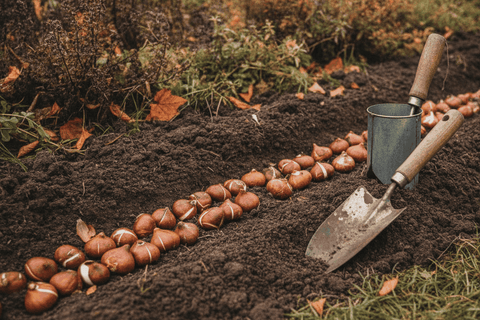
Illinois Extension's rule of thumb is two to three times as deep as the bulb is tall, measured from the bottom of the bulb. Our tulip and daffodil guides use three times the bulb's height. Iowa State University Extension's table gives these depths, measured from the base of the bulb to the soil surface:
| Bulb | Planting depth per Iowa State (to the base of the bulb) |
|---|---|
| Tulips (Darwin hybrid, triumph and other large types) | 6 to 8 in |
| Species or botanical tulips | 3 to 5 in |
| Daffodils (trumpet, large-cupped and other large types) | 6 to 8 in |
| Miniature daffodils | 3 to 5 in |
| Hyacinth | 6 in |
| Large alliums | 6 in |
| Crocus, snowdrops, grape hyacinth, Siberian squill, glory-of-the-snow | 3 to 4 in |
Sources differ on two rows. Clemson gives hyacinths 4 to 6 inches, as do our fall bulbs guide and our planting depth guide, which has depths for these and other plants on one page. For large alliums, our fall bulbs guide says 6 to 8 inches and our depth guide says 5 to 8, deeper for the big-headed kinds. The University of Minnesota Extension adds: in light, sandy soil plant an inch or two deeper, and in heavy clay an inch or two shallower.
How to use a bulb planter
- Water dry ground first. Gardeners' World suggests watering compacted or dry ground the night before; ProPlugger says to avoid dry or overly saturated soil.
- Push, twist, lift. Twist and rock a hand planter down to depth; drive a long-handled one in with your foot.
- Check the depth on the first few holes against the tables above.
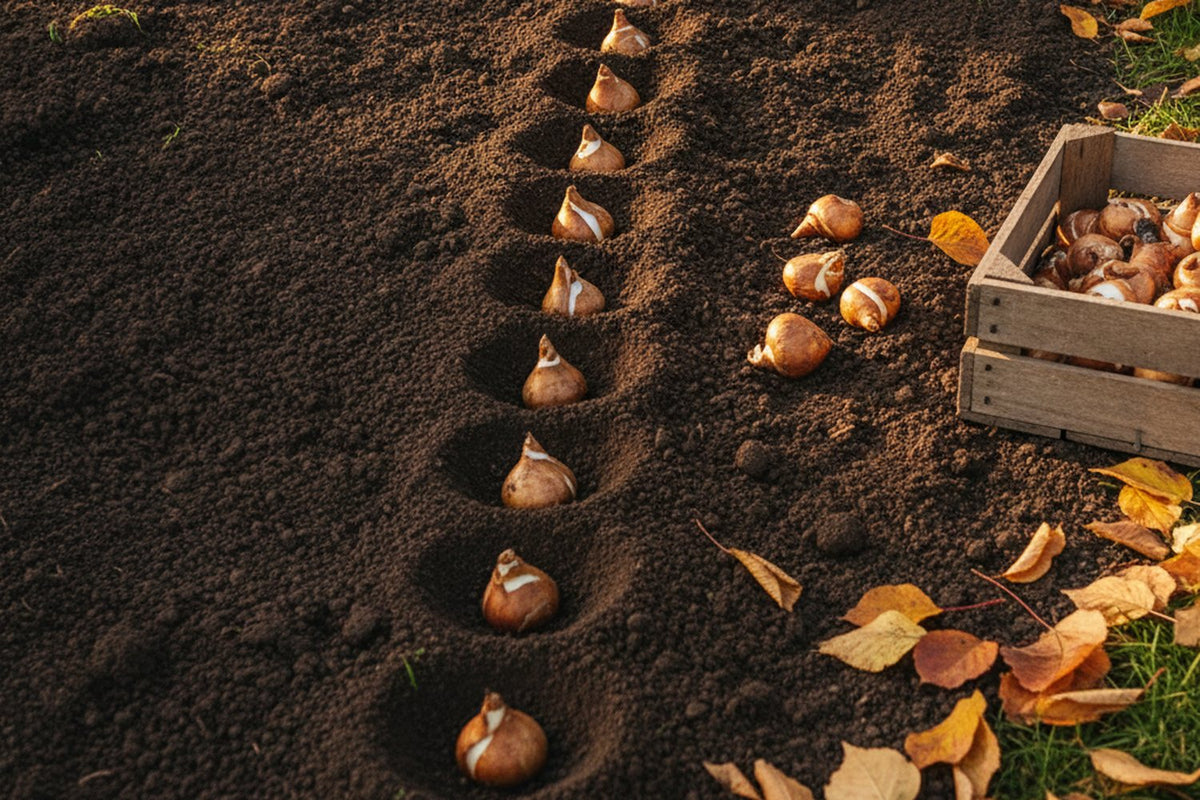
- Drop in the bulb, pointed end up. Illinois Extension says nose up, root plate down.
- Put the soil back and firm it. With a long-handled planter, Gardeners' World says the core taps out or pops out when you make the next hole.
Naturalizing bulbs in a lawn
Small bulbs in a lawn you want to keep: the soil knife (pick 5). Daffodils and other big bulbs in rougher grass: the 7 inch auger (pick 3), as Willburn does. Whatever you plant, Illinois Extension says not to mow the foliage off until it turns yellow and dies back naturally, so plant in grass you can leave long for a few weeks after bloom.
Keeping squirrels and voles off new bulbs
Iowa State Extension says tulips and crocus especially draw chipmunks, voles, mice and other animals that dig up newly planted bulbs, and that the best defense is to exclude them: roll hardware cloth or chicken wire across the soil after planting, pin it down, and remove it when the foliage emerges in spring. The University of Minnesota Extension gives the same advice for squirrels and chipmunks, and notes that daffodil bulbs are poisonous. Surface mesh stops the diggers, but voles tunnel in from the side, so our tulip guide lines the bottom and sides of the bed with quarter inch hardware cloth instead. If you use bulb baskets, Blooming Backyard says to dig a hole a bit deeper than the basket.
How to use a bulb auger safely
- Read the drill manual and wear eye protection. Blooming Backyard says to check your drill's safety precautions before adding an attachment and to wear goggles, gloves and boots, and Garden Gate's writer wears eye protection. A DeWalt safety notice on Power Planter's site, for the DeWalt drills it sells, calls for ANSI Z87.1 eye protection.
- Use a drill, not an impact driver. Power Planter's listings say its augers are for drills, not impact drivers, and ask for at least 18 volts.
- Turn the torque down. Willburn advises turning down the drill's torque setting so a heavy drill does not wrench your wrist on a larger stone; gardeners on a Dave's Garden forum report augers jerking on roots and hard clay.
- Keep it out of established beds. Willburn stopped using an auger in her planted beds because it can chew up bulbs already in the ground before you know you have hit them.
- Drill and drop, in pairs. Close holes can cave in, so Garden Gate has one person drill and the other drop and refill.
See also our picks for the best garden kneeler, the best gardening gloves and the best garden trowel, and our guide to planting garlic, which goes in the same fall afternoon.
A word from the people who wrote this
We are Spear Head Spade, and we make digging tools: double-patented spades, with over 600,000 sold. The 30 inch Mini on this list is pre-sharpened, made of tempered carbon-manganese steel, and comes in Yellow only. We put it here for one job, bulbs planted in groups among established plants and in raised beds; for single holes or a lawn, buy one of the other five, and for a whole new bed, our spade finder matches a full-size spade to your soil.
Frequently asked questions
Can you use an impact driver with a bulb auger?
Power Planter says no: its augers are designed for drills, not impact drivers, and it asks for a drill of at least 18 volts. Willburn advises turning the drill's torque setting down so it does not wrench your wrist on a stone.
How many bulbs go in one hole?
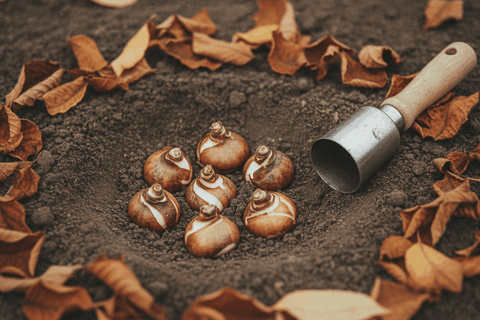
One per hole with a bulb planter or auger, as in Garden Gate's drill-and-drop method. For a fuller look, Colorado State University Extension suggests planting the same color in groups of 5 to 7 bulbs, so dig a pocket for each group.
Which way up do bulbs go?
Pointed end up. Illinois Extension says to plant tulips, daffodils and hyacinths with the nose of the bulb upward and the root plate downward. Hodgson wrote that a bulb that lands on its side will still grow and bloom, so there is no need to dig one back up if it tips over.
Disclosure: Our commissions do not change what we recommend or what you pay. We also make one product on this list, the Spear Head Mini, and we say so where it appears. Availability was checked on Amazon on September 22, 2026 and can change; we do not print prices because they move, so every "Check price" link shows today's.