As an Amazon Associate we earn from qualifying purchases. Some brands also pay us when you click or buy, so those links are ads. Full disclosure below
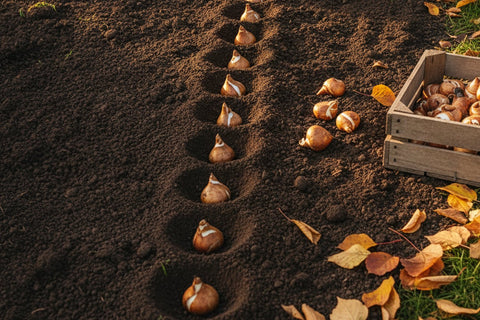
Plant tulip bulbs in fall, once soil at planting depth cools to about fifty five degrees Fahrenheit: September or October in the north, November further south. Set them three times the bulb's height deep, six to eight inches for most tulips, and four to six inches apart, pointed end up. Water once and leave them.
Almost every disappointing spring traces back to timing or depth, not to the bulbs. Daffodils go in on the same fall schedule with a few differences in depth and pests, and our daffodil planting guide covers them. If frost is forecast before your bulbs are in, our frost protection guide covers the plants still up.
When should you plant tulip bulbs?
Plant in fall, about four to six weeks before your ground freezes hard: September or October across the northern United States, October into November through the middle of the country, November or December in the warm south. That is late enough for the soil to cool and early enough for roots to grow before the ground closes. It is also the stretch when most gardeners are winterizing the garden, so the tulips can go in on the same weekend as the fall cleanup.
A more reliable signal than the calendar is soil temperature. Wait until soil at planting depth is consistently below sixty degrees Fahrenheit, and fifty five is the number most growers plant on. Warm soil encourages top growth you do not want before winter, and it invites rot. Cool soil lets the bulb root out quietly and stay dormant above ground.
Planting late beats planting early. Bulbs put in the ground in November still root and bloom, a little later in spring. Bulbs put in warm September soil in a mild climate can sprout in fall and waste themselves.
Tulip planting windows by USDA zone
Zone is a proxy for how fast your ground closes, not a rule anyone publishes. The windows below follow the months the extension services give: mid September to mid October for Minnesota, October for Iowa, November into late December for South Carolina. A soil thermometer beats all of them.
| USDA zone | Planting window | Example regions | What to watch |
|---|---|---|---|
| 3 | Mid September into early October | Northern Minnesota, Maine | The ground closes fast, do not wait for frost |
| 4 | Mid September through October | Upper Midwest, northern New England | Mulch after the ground chills |
| 5 | The month of October | Chicago, southern New England | The widest window of any zone |
| 6 | Mid October to mid November | New Jersey, Pennsylvania | Late October is the sweet spot |
| 7 | Late October to early December | Virginia, Pacific Northwest | Wait for the first cold snap |
| 8 | November to late December | Coastal Carolinas, Atlanta | Borderline, see the next section |
| 9 and 10 | Late December to mid January | Florida, southern California | Pre chilled bulbs, grown as annuals |
The local cue, if you have no thermometer, is the first week your overnight lows sit in the thirties. For every other fall bulb and when each goes in, see our fall bulbs hub.
Do tulip bulbs need chilling in zone 8 and warmer?
Yes. Tulips need a sustained cold period to set a flower, and in zone eight and warmer the ground never delivers it. Extension guidance runs from twelve to sixteen weeks at thirty five to fifty degrees, with refrigerator protocols as short as six to eight weeks. Chill the bulbs, plant in late December or January, and treat them as annuals.
Many suppliers sell pre-chilled bulbs if you would rather skip the step. To chill your own, hold them in a paper bag with a few holes punched in it in the crisper drawer, then plant once the chilling period is done.
Keep chilling bulbs away from ripening fruit. Apples release ethylene gas as they ripen, which damages the developing flower inside the bulb while the bulb still looks perfectly healthy.
There is a partial exception. Species tulips, including Tulipa clusiana and Tulipa saxatilis, perennialize far better than hybrids where winters are cool and summers dry. Do not read that as a warm climate promise: North Carolina State rates Tulipa clusiana through zone 7b and the genus through 8b, and Clemson still tells South Carolina gardeners to expect a single season. In zone nine and warmer, plan on replanting.
How deep do you plant tulip bulbs?
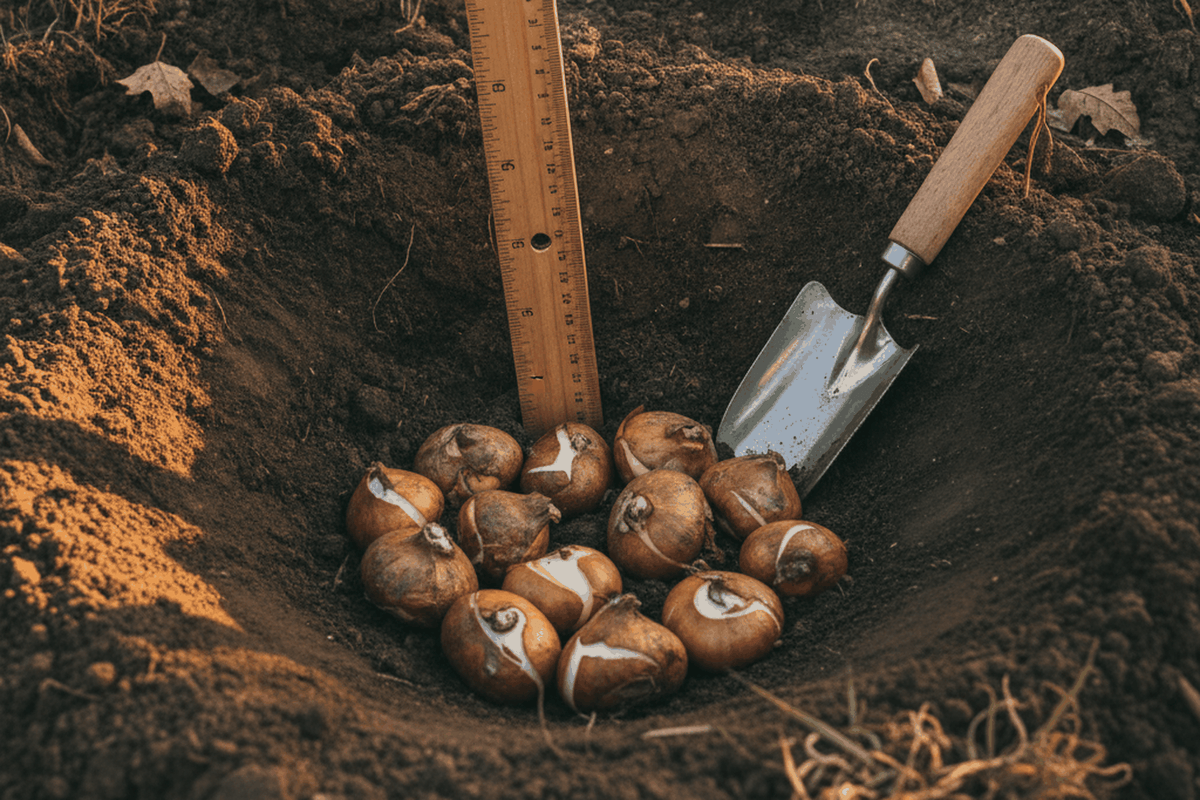
About three times the height of the bulb, which is six to eight inches deep for a full-size tulip, measured to the base of the bulb rather than the tip. Published guidance runs from two and a half to three times bulb height, so treat six inches as the floor and eight as the safe end in light soil.

Bulbs are sold by circumference, and a bigger grade is a taller bulb, so the rule scales with the bag.
| Bulb grade | Bulb height | Depth to the base of the bulb | What to expect |
|---|---|---|---|
| Top size, 12 cm circumference and up | About 2 inches | 7 to 8 inches | Largest flowers, best odds of year two |
| Standard, 10 to 12 cm | A little under 2 inches | 6 to 7 inches | The default for bagged garden center bulbs |
| Bargain grade, under 10 cm | About 1.5 inches | 4 to 5 inches | A smaller flower, sometimes none |
| Species tulips, Tulipa clusiana and kin | About 1 inch | 3 to 5 inches | Small flowers, they naturalize |
Depth is not fussiness. Minnesota Extension lists bulbs planted too shallow among the reasons a planting stops blooming, and shallow bulbs are the ones squirrels find first. Going to the deep end of the range in light soil improves both survival and how long a planting keeps flowering. Offsets too weak to flower are a crowding problem rather than a depth one. For a few bulbs at a time, a hori hori knife with depth markings on the blade measures each hole as you dig it, and our best hori hori knife guide picks one by job.
Heavy soil pushes the other way. Minnesota Extension says to set bulbs an inch or two deeper in light sandy soil and an inch or two shallower in heavy clay, and the bed itself is the better fix. Our guide to improving clay soil covers the amendments that change drainage and the ones that do not.
Set bulbs pointed end up. If you cannot tell which end is which, plant it on its side and it will sort itself out.
How far apart should tulip bulbs be?
Four to six inches apart is the standard landscape spacing, and Clemson gives that figure alongside the six to eight inch depth. It is the right answer for most gardens. What you are really choosing is how long the planting lasts, because tight spacing and long life do not go together.
| The look you want | Spacing | Bulbs per square foot | How long it lasts |
|---|---|---|---|
| Cut flower bed for vases | 2 to 3 inches | 16 to 36 | One season, replanted |
| Solid block of color | 3 to 4 inches | 9 to 16 | One to two seasons |
| Standard landscape drift | 4 to 6 inches | 4 to 9 | Two to four seasons |
| Naturalized, left in place | 6 to 8 inches | 2 to 4 | Many years, right varieties |
The tighter two rows are cut flower practice rather than published guidance; the wider two are what a planting you mean to leave alone wants. The counts assume a square grid, 144 divided by the spacing squared, and are the fastest way to work out how many bulbs to buy. A bed three feet by six feet is eighteen square feet, so a drift at four inch spacing takes roughly 160 bulbs. Do not actually set a grid: scatter them by hand and plant them where they land.
What soil and sun do tulips need?
Full sun and sharp drainage. Tulips want at least six hours of direct sun a day while the leaves are up in spring, and soil in the pH 6.0 to 7.0 range. Drainage matters more than fertility, because bulbs sitting in wet soil rot, which is the second most common failure after depth.
Anywhere that puddles after rain, raise the bed or pick another spot. Under deciduous trees is fine, because tulips finish their growing cycle before the canopy fills in. Deep shade from evergreens or a north wall gives a short stem and no flower, and Clemson lists heavy shade among the reasons an established planting quits.
Skip the bone meal. Extension services do not agree that it does anything for bulbs at all, Illinois argues it interferes with the mycorrhizae at the root tips, and it can bring dogs and other diggers to exactly the spot you planted. If your soil is poor, a low nitrogen bulb fertilizer in the backfill does the job without advertising the location.
How do you plant tulip bulbs step by step?
Six steps: check the drainage, mark the shape, open the whole area to full depth, set the bulbs pointed end up at your spacing, backfill and firm the soil, then water once. The sequence below is for a bed or a drift. For a few bulbs in an existing planting, skip ahead.
1. Check that the site drains
Dig a test hole eight inches deep, fill it with water and come back in an hour. If water is still standing, the bulbs rot there over winter however well you plant them. Move, or build the bed up four to six inches.
2. Mark the shape of the planting
Lay a hose or a rope on the ground and shape the drift before you cut anything. Curves read better than rectangles, and a drift longer than it is wide looks intentional.
3. Open the ground to full depth
Lift the soil off the whole marked area to the depth your bulbs need, six to eight inches for standard tulips, and pile it on a tarp rather than the lawn. One flat base keeps every bulb at the same depth, which is what makes the display come up even. Break up the bottom two inches with a fork.
4. Place the bulbs pointed end up
Set every bulb on the base with the point up and the root plate down, at the spacing you chose. Placing them all before you backfill is the real advantage: you see the layout and can fix anything crowded.
5. Backfill and firm the soil
Return the soil in one go, breaking up clods so nothing bridges over a bulb and leaves an air pocket. Firm the surface with the back of a rake. Loose soil signals squirrels, and firming it is the cheapest deterrent.
6. Water once, then leave them alone
Water once, thoroughly, to settle the soil and trigger rooting, then leave them alone. Fall and winter rainfall is enough, and extra water on dormant bulbs risks rot. Wait until the ground has chilled before you mulch, or you insulate warmth in rather than cold out.
Is it better to dig a trench or individual holes?
For more than about fifty bulbs, excavate the whole area rather than digging holes one at a time. A bulb planter is fine for a dozen bulbs in an established bed, but it is slow over a drift and the holes come out too shallow because most hand planters stop at about six inches, short of the eight a big tulip can want in light soil. Our bulb planter guide compares the hand planters, augers and soil knives by how deep each one reaches.

Excavating the whole area fixes both problems.
| Method | Best for | Depth control | Watch out for |
|---|---|---|---|
| Bulb planter, one hole at a time | A dozen bulbs in a planted bed | Poor, it bottoms out short | Shallow holes and sore wrists |
| Auger on a cordless drill | Bulbs scattered in open or prepared ground | Good, you set the depth | Roots and stones stalling it |
| Open trench or excavated bed | Drifts of fifty bulbs and up | Excellent, one flat base | Somewhere to put the soil |
| Layered pot | Containers and doorsteps | Excellent | Pot depth limits the bottom layer |
A digging spade does the whole job: cutting the outline, lifting the soil cleanly, and slicing any roots on the way down. Ours is double-patented, with a blade curved to carry soil like a shovel and drawn to a point that cuts like a spade, a foot rest to put your weight on, and a profile that takes the path of least resistance around a rock rather than stopping dead on it. If the area is grassed over, our guide on cutting a clean bed edge covers taking the turf off first.
How do you plant tulips in pots?
Pots are the reliable route if your ground is wet, your soil is solid clay, or squirrels have beaten you twice. Use a container with drainage holes and at least twice the depth the bulbs need, so twelve inches across and twelve deep is the floor. Fill it with potting mix, not garden soil, which stays wet in a pot.
Plant far tighter than you would in the ground. A twelve inch pot takes about twenty tulip bulbs and a sixteen inch pot thirty or more, shoulder to shoulder without quite touching. Oregon State packs twenty to thirty into a fourteen inch pot, so crowding is the point.
The catch is cold. Soil in a pot swings with the air temperature, so Illinois Extension advises treating a container as two hardiness zones colder than your ground. Aim for somewhere that holds between twenty and forty five degrees over winter: an unheated garage, or the pot sunk in the ground and mulched over. It needs cold, not light.
When green tips appear, move it into bright indirect light for a few days before full sun. Do not count on a second year, because hybrid tulips in pots rarely repeat. Let the foliage die back, then either leave the pot to go dormant or lift the bulbs and replant them in a border in fall.
The lasagna method, layer by layer
The lasagna method stacks bulbs in layers inside one pot, deepest first, so a container flowers for two months instead of two weeks. Each layer sits at roughly the depth that bulb would want on its own, and shoots from the lower layers find their way around the bulbs above them.
| Layer | Depth below the surface | What goes in it | When it blooms |
|---|---|---|---|
| Bottom | 7 to 8 inches | Late tulips, daffodils | Mid to late spring |
| Middle | 4 to 6 inches | Early tulips, hyacinths | Early to mid spring |
| Top | 2 to 3 inches | Crocus, muscari, scilla | Late winter |
Three layers need about fourteen inches of pot depth. Offset each layer rather than stacking bulbs directly on one another. One caution from Oregon State: grape hyacinth dominates a mixed pot, so give it its own container if the tulips are the point.
How do you keep squirrels and voles from digging up tulip bulbs?
Exclusion, not repellents. Firm the soil back down, clear away the papery bulb skins that smell like a signpost, and plant at the deep end of the range. Then lay wire mesh over the bed and pin it down, which is the one measure the extension services rate as reliable.
Half inch hardware cloth over the surface stops squirrels, and shoots grow up through it in spring so you can lift it once they are established. Voles come in through tunnels from the side, so surface mesh never reaches them, and UC integrated pest management puts the vole mesh size at quarter inch or smaller. Our mole and vole repellent picks cover the ground level options.
Clemson's line is that the only sure protection is to enclose the bulbs in wire mesh at planting. Against voles that means a cage rather than a lid: line the excavated bed bottom and sides with quarter inch hardware cloth, set the bulbs, then fold it over the top. Fussy once, permanent afterward.
Deer and rabbits work above ground and take the buds instead. Iowa State puts tulips on the highly desirable list for deer, rabbits, chipmunks, voles and mice alike, so in a browsed garden the flowers still need protecting after the mesh comes off. Our picks for the best deer repellent cover what holds through a season, and fencing around the emerged foliage is the version that always works.
Daffodils carry the alkaloid lycorine and rodents leave them alone, so where pressure is worst plant daffodils instead of tulips rather than mixing the two and hoping. Repellent sprays are the weakest option: Iowa State notes they need reapplying after rain and are less effective than gardeners expect.
Do tulips come back every year?
Some do, and most sold for bedding do not. Modern hybrid tulips are bred for one spectacular season and often decline afterward, particularly in warm or wet climates. Darwin hybrids and species tulips perennialize far better. Many gardeners treat large-flowered hybrids as annuals and replant, which is legitimate, not a failure.
If returning matters more than flower size, plant Darwin hybrids, the Fosteriana tulips sold as Emperors, Greigii varieties, or species tulips such as Tulipa clusiana and Tulipa tarda. Iowa State calls Darwin hybrids the longest blooming hybrid tulip and species tulips the longest lived of all. Give them the deep end of the depth range, the wide end of the spacing range, six hours of sun and soil that never stays wet. The usual reasons a planting fades are avoidable: bulbs set too shallow, foliage cut down green, too much shade, and crowding.
What do you do with tulips after they bloom?
Let the foliage yellow and die back naturally before removing it. Those leaves are recharging the bulb for next year, and cutting them green is why many plantings fade after one good season. Deadhead spent flowers so the plant does not put energy into seed.
Six weeks is the useful number. Clemson says to leave the leaves at least six weeks after bloom finishes, or until they turn brown. Do not braid or tie the foliage tidy, and do not pull it early.
Feed a perennializing planting once a year, either as new growth emerges in spring or right after the petals drop, never both and never while it is in bloom, using a low nitrogen bulb fertilizer such as 5-10-5. To lift and store bulbs, wait until the foliage has yellowed and withered, dry them two to three weeks somewhere airy and shaded, then hold them in mesh bags at fifty to sixty five degrees until fall.
Tools for this job
What the mass-planting method above calls for, plus the two things that keep rot and squirrels away.

Spear Head Spade 40 inch D-Handle Garden Spade
Cuts the outline of the drift and lifts the top six to eight inches of soil cleanly onto a tarp, which is the fast way to plant fifty bulbs at once.
Power Planter 3 inch by 24 inch garden auger
Bores individual holes a full eight inches deep from a standing position, so they do not bottom out shallow. It has a half inch hex drive, so use a cordless drill with a half inch chuck; Power Planter calls for at least 18 volts and says not to use an impact driver.
Check price on AmazonEspoma Organic Bulb-tone 3-5-3
A balanced bulb fertilizer to work into the backfill instead of bone meal, which the guide says attracts diggers.
Check price on AmazonYARDGARD half inch galvanized hardware cloth
Half inch mesh to pin over the planting area against squirrels, then lift once the shoots are up in spring.
Check price on Amazon
Spear Head Spade Garden Kneeler
Setting dozens of bulbs in an open trench is done on your knees, and a pad keeps it comfortable.
Common questions
When should you plant tulip bulbs?
In fall, four to six weeks before the ground freezes, once soil at planting depth has dropped below sixty degrees Fahrenheit. That is September or October in northern regions and November further south. In zone eight and warmer, pre-chill and plant in January.
What month is best to plant tulip bulbs?
October, across most of the United States. September suits zones three and four, October covers zones five through seven, November and December suit zone eight, and zone nine and warmer plant pre-chilled bulbs in January.
How deep do you plant tulip bulbs?
About three times the height of the bulb, which is six to eight inches for full-size tulips, measured to the base of the bulb. Go an inch or two deeper in light sandy soil and an inch or two shallower in heavy clay.
How far apart should you plant tulip bulbs?
Four to six inches apart for a standard landscape drift, which is four to nine bulbs per square foot. Two to three inches apart for a cut flower bed you replant yearly, six to eight inches for a naturalized planting.
Can you plant tulip bulbs in spring?
Not usefully. Tulips need a long cold period to form flowers, so bulbs planted in spring have not had it and are unlikely to bloom that year. If you find forgotten bulbs, plant them anyway and treat anything that appears as a bonus.
Which end of a tulip bulb goes up?
The pointed end. The flat end with the root plate goes down. If a bulb is ambiguous, plant it on its side and it corrects itself.
How many tulip bulbs go in one hole?
In the ground, one bulb per hole with four to six inches between them, or five to seven in one wide hole for a fuller clump. In a twelve inch pot, about twenty bulbs shoulder to shoulder.
Do tulip bulbs multiply if left in the ground?
They produce offsets, but on most hybrid tulips those are too small to flower and they compete with the parent bulb, so the planting thins each year. Species tulips and Darwin hybrids genuinely multiply.
Are tulips better in pots or in the ground?
In the ground if you want them to return, since hybrid tulips in pots rarely repeat. In pots if your soil drains badly, if squirrels have beaten you, or if there is no soil at all.
What should not be planted next to tulips?
Extension sources name no plant to keep away from tulips. The constraint is drainage, not neighbours. Iowa State and Missouri Botanical Garden suggest the opposite: plant tulips among hosta, daylilies, coneflowers and ornamental grasses, which leaf out later and hide the ripening foliage.
Do you have to soak tulip bulbs before planting?
No. Anemone and ranunculus corms are the ones that want a presoak. Tulip bulbs do not need it, and many bulbs rot if they get it. Plant them dry, then water the bed once after backfilling to settle the soil and start root growth.
How do you stop squirrels digging up bulbs?
Plant deeper, firm the soil down, clear away loose bulb skins, and skip bone meal, which brings diggers in. For persistent problems, pin wire mesh over the area until shoots come through. Rodents leave daffodils alone, so plant those where pressure is worst.
Disclosure: some links in this guide are affiliate links to Amazon. This is at no extra cost to you, and it never changes our honest recommendations.
Product prices and availability are accurate as of the date/time indicated and are subject to change. Any price and availability information displayed on Amazon.com at the time of purchase will apply to the purchase of this product.