As an Amazon Associate we earn from qualifying purchases. Some brands also pay us when you click or buy, so those links are ads. Full disclosure below
The bulbs to plant in fall are the spring flowering ones: tulips, daffodils, hyacinths, crocus, alliums, snowdrops, grape hyacinth, fritillaria and Siberian squill. All go in once the soil drops below about sixty degrees Fahrenheit at planting depth, six to eight weeks before the ground freezes hard, at about three times the height of the bulb.
This guide is the short version: which ones, how deep and how far apart, when to plant in your region, the two planting methods worth using, layering in a pot, and keeping squirrels and voles out. This page is one stop on our fall yard cleanup tools checklist, which puts every fall job in order.
The main bulbs to plant in fall
Nine bulbs cover almost every fall planting, listed in the order they bloom, because sequence is what turns a bulb bed into ten weeks of flowers instead of one. Depths are measured from the base of the bulb to the soil surface.
| Bulb | Planting depth | Spacing | Bloom time | Deer and rodent resistance |
|---|---|---|---|---|
| Snowdrop (Galanthus) | 3 to 4 inches | 3 inches | Late winter | High. Deer and rodents leave it alone |
| Crocus | 3 to 4 inches | 2 to 3 inches | Late winter to early spring | Low. Squirrels dig the corms, voles eat them, deer browse the flowers |
| Siberian squill (Scilla siberica) | 3 to 4 inches | 3 inches | Early spring | High. Deer and rodents pass it by |
| Daffodil | 6 to 8 inches, 3 to 4 for miniatures | 4 to 6 inches | Early to mid spring | High. Bitter in every part, so deer, rabbits and rodents skip it |
| Grape hyacinth (Muscari) | 3 to 4 inches | 3 inches | Mid spring | High. Rarely browsed and rarely dug |
| Hyacinth | 6 inches | 5 to 6 inches | Mid spring | High. Rodents leave the bulbs alone, deer may take a flower |
| Fritillaria (crown imperial) | 6 to 8 inches | 8 to 12 inches | Mid to late spring | High. The musky smell puts deer and rodents off |
| Tulip | 6 to 8 inches | 4 to 6 inches | Mid to late spring | Low. Deer eat the flowers and squirrels dig the bulbs |
| Allium | 6 inches for large types, 3 to 5 for small | 6 to 8 inches | Late spring to early summer | High. The onion scent keeps deer and rodents off |
Where a range is given, the deeper number is for light sandy soil and the shallower one for heavy clay. For an odd-sized bulb, fall back on the rule the table is built from: about three times its height, measured to the base. Pointed end up, flat root plate down, and if a bulb is genuinely ambiguous, lay it on its side and it will right itself. Crown imperial is the deliberate exception, and goes in on its side every time so that water drains off its hollow crown instead of standing in it. Our planting depth guide puts every bulb's depth on one page you can take outside. Depth markings on a hori hori knife's blade let you check each bulb's depth hole by hole, and our hori hori knife guide compares seven of them.
Two of these spread hard. Siberian squill and grape hyacinth both seed themselves into lawns and beds, and squill is listed as invasive in parts of the Northeast and upper Midwest, so keep it away from woodland edges. Grape hyacinth also sends up grassy leaves in fall, months before it flowers, which is normal rather than a mistake.
What does not go in this fall
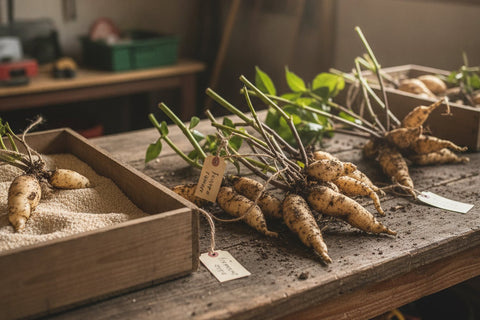
Tender summer bulbs are a spring job. Dahlias, gladiolus, canna and caladium do not survive a northern winter in the ground, so they go in after the last frost. If yours are already planted, lift them after the first frost; our guide on how to store dahlia tubers covers lifting, dividing and storing dahlias, and our guide on how to winterize your garden covers the rest of the fall list. Lilies can be planted in fall or spring at six to eight inches, and unlike the rest their bulbs should never be allowed to dry out. Garlic is a fall planting on the same schedule as the flowers; our guide to planting garlic covers it.
When to plant bulbs in fall, by region
Soil temperature is the real signal. Once the soil at planting depth has dropped below about sixty degrees Fahrenheit, usually after a week or two of cool nights, the window is open, and tulips do better still if you wait until it is nearer fifty five. Bulbs put into soil still warm from summer are the ones that rot, since the fungus that softens a bulb needs warmth and moisture together.
| Region | Typical planting window |
|---|---|
| Zones 3 to 5 (northern states, upper Midwest, mountain West) | Mid September to mid October |
| Zones 6 to 7 (Mid-Atlantic, Ohio Valley, lower Midwest) | October to mid November |
| Zones 8 to 9 (Deep South, Gulf Coast, coastal California) | Mid November to December |
| Zone 10 and warmer | Pre-chilled bulbs in December, or types that need little cold |
Aim for about six weeks of workable soil after planting, which is the rooting time a bulb wants. The practical last call is two to four weeks, and bulbs planted that late still bloom, a little shorter and later.
Order matters inside the window. Daffodils and the small early bulbs go in first, because they root slowly and want every cool week they can get. Tulips go in last and are happier for it: a tulip in warm September soil can start into growth in fall and waste itself, while a tulip planted in November roots quietly and blooms on time. Our daffodil planting guide and tulip planting guide cover each in detail.
Warm climates and pre-chilling
Tulips and hyacinths need a sustained cold period to bloom, commonly given as about twelve weeks at roughly thirty eight to fifty degrees, and in zone 8 and warmer the ground never delivers it. Either buy pre-chilled bulbs, or chill your own in a refrigerator for twelve weeks and plant them in late December or January, treating them as annuals for one good season. Keep chilling bulbs away from ripening fruit: the ethylene gas apples give off kills the flower bud inside a bulb that still looks healthy.
For a warm climate planting that comes back on its own, plant the bulbs that need little chill: paperwhite and other tazetta daffodils, jonquilla types such as Trevithian, and species tulips such as Tulipa clusiana. Large alliums are not on that list, since they want a real winter.
Two ways to plant fall bulbs
The choice is only about how many bulbs are going into one place.

The trench method, for a drift
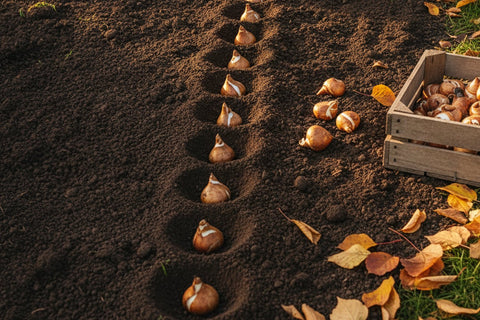
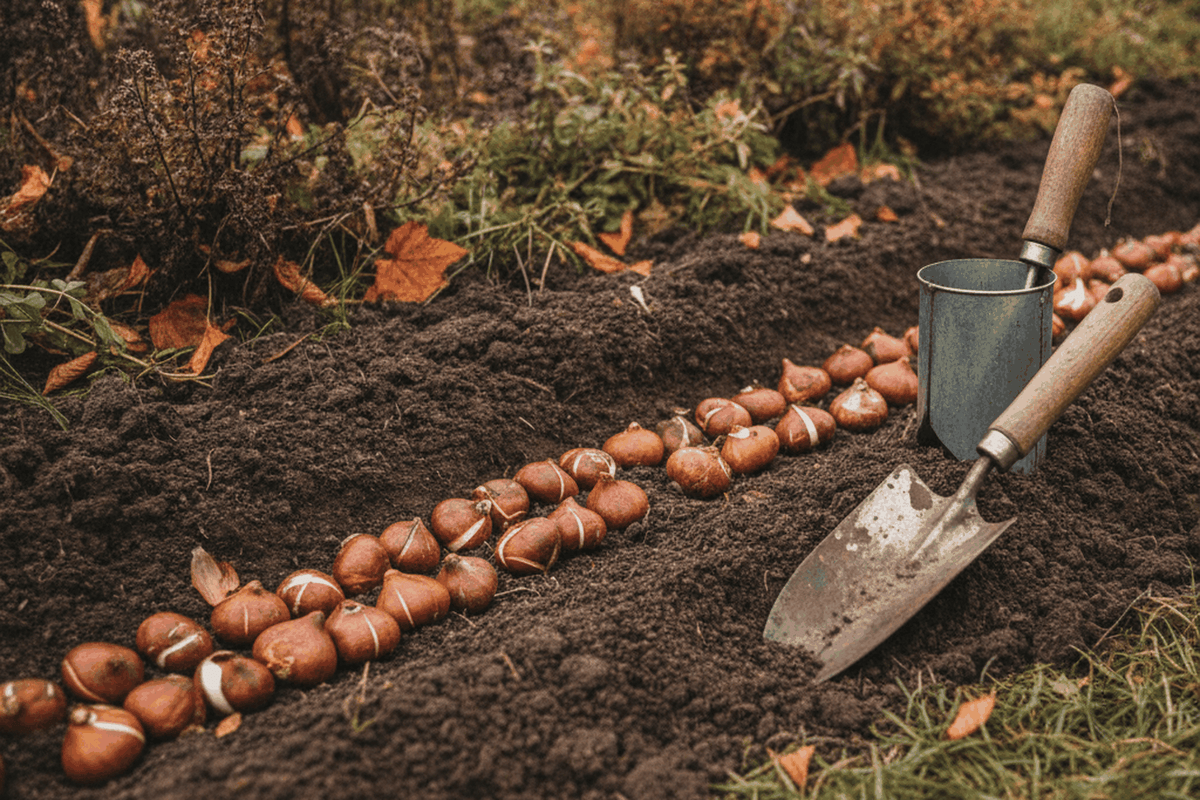
For fifty or a hundred bulbs going into one area, open the whole area at once instead of digging a hole per bulb. Mark the outline with a hose, cut it with the spade held vertically, then lift the top six to eight inches of soil in slabs onto a tarp. Loosen and feed the floor of the trench, stand all the bulbs up in their clusters, then slide the soil back in one go.
Three things make this better than individual holes: every bulb ends up at the same depth, you can see the spacing before anything is buried, and it is far faster. A Spear Head Spade is the tool for it, since the pointed, sharpened blade cuts down through sod and small roots rather than bouncing off them, and the 40 inch D-handle gives the leverage to lever each slab out whole, with up to 80% less effort than a standard shovel. Setting the bulbs is a few minutes on your knees, and a kneeler makes them comfortable ones.
The single hole method, for scattered bulbs
For a dozen bulbs going in here and there in open or prepared ground, drill the holes. A three inch by twenty four inch garden auger in a cordless drill bores a full six to eight inch hole from a standing position in seconds and leaves loose soil at the bottom for new roots. One bulb per hole, never stacked, a pinch of fertilizer, backfill and move on.
Hand bulb planters, the tube type you push in and twist, work in soft soil and stall in clay or roots, and most stop at about six inches, so check the depth on the first few. Between established perennials or older bulb plantings, skip the auger: it can chew up bulbs already under the surface before you know you have hit them, so dig a small pocket for each group instead. Our bulb planter guide compares the hand planters, augers and soil knives by how deep each one reaches.
Layering bulbs in a pot
Layered containers, sometimes called lasagna planting, get the most out of a bag of bulbs, because one pot can flower for six weeks from a spot by the door where you will actually see it.
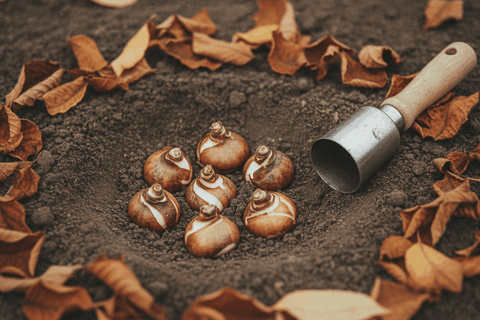
Use a pot at least twelve inches deep and wide with real drainage holes. Put two inches of mix in the bottom, then work up from the deepest bulbs in the table: tulips and daffodils about eight inches from the rim, an inch or two of mix over them, then hyacinths, more mix, then crocus, grape hyacinth or squill in the top three inches. Bulbs can sit closer in a pot than in the ground, close but not touching, and the layers need not line up.
Water once after planting, then keep the pot barely moist rather than wet. What ruins layered pots is winter cold in a container, since a pot freezes solid in a way garden soil does not. In zone 6 and colder, move it into an unheated garage or shed, or sink it in the ground and mulch over the top, so the bulbs chill without the roots freezing through.
Keeping squirrels and voles out
Squirrels find bulbs by scent and by loose soil, so the first defenses cost nothing. Firm the soil back down, rake away the papery bulb skins, which smell like a signpost, and water the bed once so it settles. Skip the traditional handful of bone meal in every hole, which supplies little beyond phosphorus and brings dogs, skunks and raccoons to dig exactly where you planted. If the same squirrels are emptying your bird feeder, our squirrel-proof bird feeder guide covers feeders and baffles that keep them off.
Where squirrels are a real problem, lay half inch galvanized hardware cloth over the planting area and pin it down with landscape staples. Shoots come up through the mesh in spring and you can lift it once they are established. Voles tunnel in from the side instead, so for anything they favor the mesh has to line the hole, sides and bottom. Planting at the deep end of the range helps against both. Mesh does nothing about the runs themselves, so where voles or moles are already working the bed, our mole and vole repellent picks cover the castor oil granules and traps that change the tunnelling. Deer are a spring problem rather than a fall one, since they browse the flowers rather than the bulbs, and our deer repellent picks cover what keeps them off tulips once the buds are up.
The simplest answer is to choose bulbs animals mostly ignore. Daffodils, alliums, snowdrops, fritillaria and squill all qualify. Interplanting daffodils among tulips gives the tulips some incidental cover and spreads the bloom season out at the same time.
What to do after they bloom
Deadhead the spent flowers so the plant does not put energy into seed, then leave the leaves alone for at least six weeks, until they yellow and flop on their own. They are refueling the bulb for next year, and cutting, mowing, tying or braiding them while green is the most common reason a planting fades after one good season.
Feed as the shoots come up in early spring, with a complete bulb fertilizer such as Espoma Bulb-tone rather than a high nitrogen lawn product, which gives you leaves at the expense of flowers. Once the foliage has died back, let the bed go dry, since watering dormant bulbs in heavy soil rots them.
Hide the dying foliage rather than removing it, by planting bulbs among perennials that leaf out as they fade, such as daylilies, hostas, hardy geraniums and catmint.
Tools for this job
The short list for a fall bulb planting, whether you are opening a trench for a drift or drilling single holes.

Spear Head Spade 40 inch D-Handle Garden Spade
Cuts the outline of a drift and lifts the top six to eight inches of soil onto a tarp, which is how fifty bulbs end up at one depth.
Power Planter 3 inch by 24 inch garden auger
Bores a full six to eight inch hole from a standing position for bulbs going into open or prepared ground, where a trench makes no sense.
Check price on AmazonEspoma Organic Bulb-tone 3-5-3
A complete 3-5-3 bulb fertilizer for the backfill and the early spring feed, instead of bone meal alone, which draws diggers.
Check price on AmazonYARDGARD half inch galvanized hardware cloth
Pinned over a new bed it stops squirrels digging until the shoots come through, and lining a hole with it is what stops voles tunneling in from the side.
Check price on Amazon
Spear Head Spade Garden Kneeler
Setting a whole drift of bulbs in an open trench is done on your knees, and a pad keeps it comfortable.
Common questions
When is it too late to plant bulbs?
As long as you can dig, it is not too late. Bulbs want two to four weeks of unfrozen soil to root, so a December planting in a mild region still blooms, a little later and shorter. If the ground has frozen, plant them in pots in an unheated garage. Bulbs left in the bag until spring will not flower.
How deep do you plant bulbs?
About three times the height of the bulb, measured to its base rather than its tip. That is six to eight inches for tulips and daffodils, about six for hyacinths and large alliums, and three to four for crocus, snowdrops, grape hyacinth and Siberian squill. Go deeper in light sandy soil and an inch shallower in heavy clay.
Do you need to water bulbs after planting?
Water once, thoroughly, to settle the soil and start the roots, then leave them alone. Fall and winter rainfall is normally enough, and watering dormant bulbs in heavy soil is one of the common ways to rot them. Containers are the exception, since a pot dries out on its own and needs checking in a dry spell.
Can you plant bulbs in pots?
Yes, and a pot is the best way to layer several kinds for six weeks of bloom. Use a container twelve inches deep with drainage holes and set the largest bulbs in the lowest layer. In zone 6 and colder, move the pot into an unheated garage or sink it in the ground so it chills without freezing solid.
Which bulbs come back every year?
Daffodils, crocus, grape hyacinth, snowdrops, Siberian squill and the smaller alliums come back and multiply for years with no help. Hyacinths return smaller each season. Large hybrid tulips usually fade after a year or two, while Darwin hybrid and species tulips are the ones that keep going.
The bottom line
Plant fall bulbs once the soil drops below about sixty degrees, aiming for six weeks of rooting time before the ground freezes hard, at three times the height of the bulb, daffodils in first and tulips last. Open a trench for a drift and drill single holes for anything scattered. Firm the soil, water once, then leave the foliage alone next spring for six weeks after bloom. That is the whole job.
While the soil is still warm, the same afternoon is the right time to plant garlic and to plant peonies, which are not bulbs and go in with the eyes only one to two inches deep.
Disclosure: some links in this guide are affiliate links to Amazon. This is at no extra cost to you, and it never changes our honest, use-based recommendations.