As an Amazon Associate we earn from qualifying purchases. Some brands also pay us when you click or buy, so those links are ads. Full disclosure below
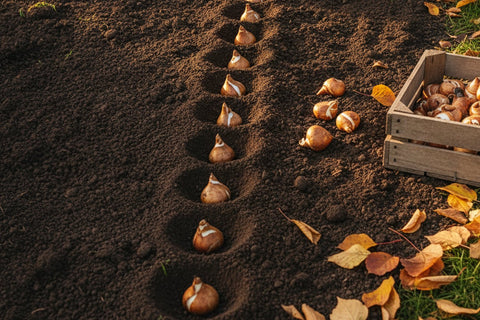
Plant daffodil bulbs in fall, once the soil at planting depth cools to about sixty degrees Fahrenheit and no later than two to four weeks before the ground freezes. Set each bulb pointed end up at three times its height, about six inches for the large types, four to six inches apart, in soil that drains.
Daffodils are the most forgiving bulb you can plant. They come back for decades, they multiply on their own, and deer, rabbits, squirrels and voles leave them alone. Get three things right in fall: timing, depth and drainage. The rest takes care of itself.
This guide covers how to plant daffodil bulbs from start to finish: when to plant by region, depth and spacing, the trench method for a whole drift, feeding, and what to do after they bloom.
When to plant daffodil bulbs
Plant daffodil bulbs in fall, once the soil has cooled and no later than two to four weeks before the ground freezes. That gives the bulb time to grow roots in cool soil while it stays dormant above ground. Daffodils need twelve to sixteen weeks of cold to bloom, and a winter in the ground supplies it everywhere except the warm south. Our fall bulbs hub covers the rest of the fall bulbs alongside these. Those same weeks before the ground freezes are the time to winterize the rest of the garden, so the bulbs and the bed cleanup can share a weekend.
Soil temperature is a better cue than the calendar. Once the soil at planting depth has dropped to about sixty degrees Fahrenheit, usually after a week or two of cool nights, it is time. Soil still warm from summer invites basal rot, the fungus that turns a bulb soft before it ever roots.
| Region | Typical planting window |
|---|---|
| Zones 3 to 5 (northern states, upper Midwest, mountain West) | Mid September to mid October |
| Zones 6 to 7 (Mid-Atlantic, Ohio Valley, lower Midwest) | October to mid November |
| Zones 8 to 9 (Deep South, Gulf Coast, coastal California) | Mid November to December |
| Zone 10 and warmer | Pre-chilled bulbs in December, or tazetta types that need little cold |
Within that window, early beats late. Daffodils root slowly and want as many weeks of cool soil as they can get before it freezes, which is why they go in ahead of tulips. Late still beats never: bulbs planted in December in a mild climate will root and bloom, a little shorter and later than usual. Bulbs forgotten in a paper bag until spring will not.
Warm climates
In zone 9 and warmer, and in the hottest parts of zone 8, the soil may not stay cold long enough for the big trumpet daffodils to bloom reliably. Pre-chilled bulbs solve that for one season. For a planting that returns, choose tazetta and jonquilla types, which need little chill: Paperwhites, Grand Soleil d'Or, and jonquilla hybrids such as Trevithian.
Where to plant daffodils
Daffodils want at least six hours of sun while they are in leaf, which runs from late winter until the foliage dies back in early summer. Under deciduous trees counts as sun, because the bulbs finish most of their growing before the canopy fills in. Deep shade gives you leaves and few flowers.
Drainage matters more than fertility. A bulb sitting in cold, wet soil all winter rots, and that is the most common way to lose a planting. Anywhere that puddles after rain is out. Heavy clay is workable if you plant an inch shallower than usual and mix compost into the backfill so water moves through; our guide to improving clay soil covers the longer fix.
Daffodils naturalize, meaning they multiply and spread without help, so they suit the places you never want to replant: a meadow strip, rough grass under fruit trees, the far edge of the lawn. Once settled, a clump keeps flowering for twenty years or more.
They are also the bulb that animals leave alone, which is not true of tulips or crocus. Every part of a daffodil carries a bitter alkaloid, so deer and rabbits skip the foliage and squirrels, chipmunks and voles skip the bulbs. The bulbs are poisonous if eaten, so keep them away from the kitchen, where they have been mistaken for onions. Being skipped is not the same as being left in peace, because a vole run still heaves a bulb out of place on its way past, and our mole and vole repellent picks cover what to do about the tunnels themselves.
How deep to plant daffodil bulbs
The rule is three times the height of the bulb, measured from the base of the bulb to the soil surface. For the large trumpet types that is about six inches, and up to eight in light, sandy soil. For miniatures such as Tete-a-Tete, three to four inches. If you are between sizes, go deeper rather than shallower.

Depth is what protects the bulb. Shallow bulbs heave out in freeze and thaw cycles and split into a crowd of small non-flowering bulbs within a couple of years. Deep bulbs stay cool, stay put and keep flowering.
Pointed end up, flat root plate down. Many bulbs arrive double-nosed, with two points on one base. Plant those as a single bulb. If one is somehow ambiguous, set it on its side and it will right itself.
Our planting depth guide has the numbers for daffodils, tulips, alliums, garlic and the rest on one page.
How far apart to plant daffodils
Four to six inches between bulbs. Large bulbs at six, miniatures at three to four. That reads as a full clump in the second spring rather than the fourth.
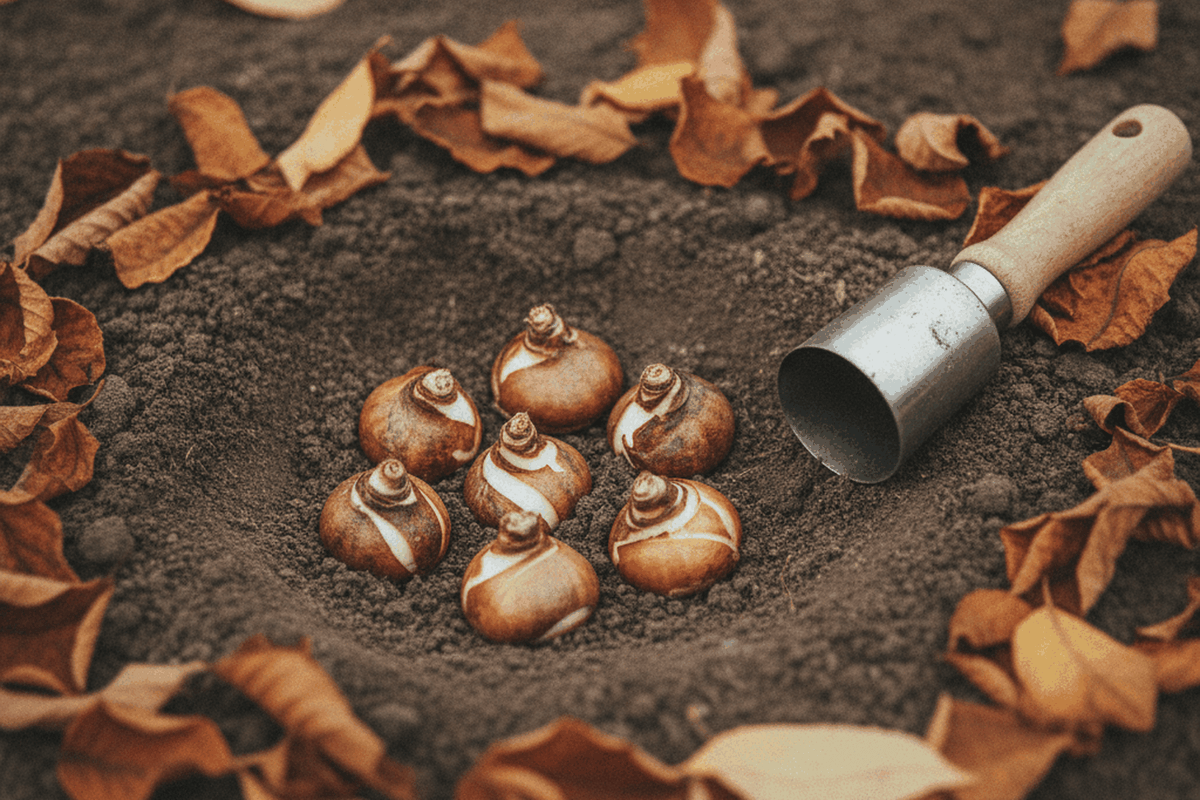
For a natural look, plant in clusters of five to seven rather than in rows. The old trick still works: toss a handful of bulbs across the area and plant each one where it lands, nudging any that fall closer than four inches. Rows of daffodils look like a parade. Clumps look like they grew there.
Keep a foot or two between clusters. A cluster of five bulbs can be twenty in five years.
The fast way to plant a drift: the trench method
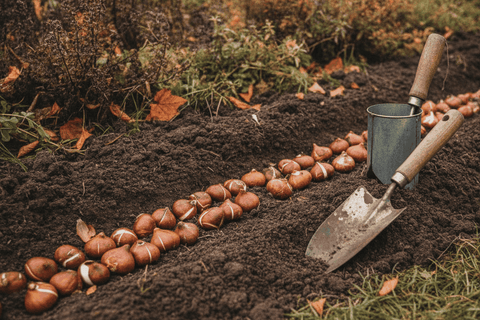
Digging one hole per bulb with a hand planter is fine for a dozen. For fifty or a hundred it is slow, and the holes end up shallow because most hand planters stop at about six inches, short of the eight a trumpet daffodil can want in light soil. The faster method is to open the whole planting area at once.
1. Mark the shape
Lay a hose or a length of rope in the outline of the drift. Long, irregular teardrops look better than circles. Cut the outline with the spade held vertically so the edge stays clean.
2. Lift the soil out
Lift the top six to eight inches of soil in slabs and set them on a tarp beside the bed. A Spear Head Spade is the tool for this: the pointed, sharpened blade cuts down through sod and small roots rather than bouncing off them, and the 40 inch D-handle gives you the leverage to lever each slab out whole, with up to 80% less effort than a standard shovel. In containers and tight beds the 30 inch Mini does the same job in less room.
3. Loosen and feed the base
Chop the floor of the trench a few inches deeper so roots go down easily, and work a bulb fertilizer into it at the rate on the bag. Mix a little more into the soil on the tarp. Bone meal alone is not enough, for reasons covered below.
4. Set the bulbs
Stand the bulbs pointed end up on the floor of the trench in their clusters, four to six inches apart. You can see the whole layout before anything is covered, so every bulb ends up at the same depth and nothing is crowded. It is a few minutes on your knees, and a kneeler makes them comfortable ones.
5. Backfill, water and mulch
Slide the soil back off the tarp, firm it gently, and water once, thoroughly, to settle the soil and start the roots. Then leave them alone. Once the ground has cooled, add two to three inches of shredded leaves or straw. Mulch evens out freeze and thaw cycles and keeps bulbs from heaving, but wait for cold ground or it holds warmth in.
For a drift in lawn, cut an H shape in the turf with the spade, fold the flaps back, plant beneath them, and fold them down again. The grass knits back in a couple of weeks.
The single-hole method
For scattered spots in open or prepared ground where a trench makes no sense, drill the holes. A three inch by twenty four inch garden auger in a cordless drill with a half inch chuck bores a hole a full six to eight inches deep from a standing position in seconds, and leaves loosened soil at the bottom for new roots. One bulb per hole, a pinch of fertilizer, backfill, move on.
Hand bulb planters, the tube type you push in and twist, work in soft soil and stall in clay or roots. A sturdy trowel does the same job in loose ground, and our garden trowel picks cover the ones that survive being levered. The most common mistake with single holes is stopping where the tool did, so check the depth on the first few. Between established perennials or older bulb plantings, skip the auger: it can chew up bulbs already under the surface before you know you have hit them, so dig a small pocket for each group instead. Our bulb planter guide compares every single-hole tool by how deep it reaches.
Feeding daffodils
Daffodils are not heavy feeders, but they do respond to a complete bulb fertilizer worked into the soil at planting, a 3-5-3 blend such as Espoma Bulb-tone. Feed again in early spring as the shoots emerge. Skip high nitrogen lawn products, which give you leaves at the expense of flowers.
The traditional handful of bone meal in every hole is a poor choice on its own. Modern bone meal is steamed and supplies little beyond phosphorus, which most garden soils already have enough of, and the smell draws dogs, skunks and raccoons to dig exactly where you planted.
After they bloom
Deadhead the spent flowers so the plant does not spend energy on seed, then leave the leaves alone for at least six weeks, until they yellow and flop on their own. The foliage is refueling the bulb for next year, and cutting, mowing, tying or braiding it green is the number one reason a planting fades after a good first season.

If the dying foliage bothers you, plant daffodils among perennials that leaf out as the bulbs fade. Daylilies, hostas, hardy geraniums and catmint all do the job. In lawn areas, mow around the clumps until the leaves have yellowed, usually six to eight weeks after bloom. Then let the bed go dry; watering dormant bulbs in heavy soil rots them.
Dividing daffodils
A clump that has gone mostly to leaves with a few small flowers is overcrowded, which typically happens after three to five years, sooner in rich soil. Lift it after the foliage has died back in early summer, working the spade well outside the clump so you do not slice bulbs. Pull the bulbs apart at the base, discard any that are soft, and replant the largest right away at the proper depth and spacing.
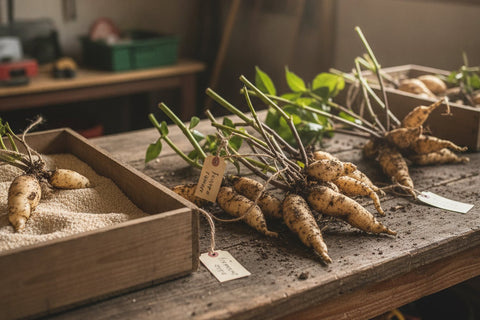
If you would rather wait for fall, dry the bulbs for a week in a shaded, airy spot and store them in mesh bags somewhere cool until planting time.
Tools for this job
What the trench method and the single-hole method actually call for, in the order you will reach for them.

Spear Head Spade 40 inch D-Handle Garden Spade
Cuts the outline of the drift and lifts the top six to eight inches of soil onto a tarp, which is the fast way to set fifty bulbs at one depth.
Power Planter 3 inch by 24 inch garden auger
Bores a full six to eight inch hole from a standing position for bulbs going into open or prepared ground, where a trench makes no sense. It has a half inch hex drive, so use a cordless drill with a half inch chuck; Power Planter calls for at least 18 volts and says not to use an impact driver.
Check price on AmazonEspoma Organic Bulb-tone 3-5-3
A complete 3-5-3 bulb fertilizer for the backfill and the early spring feed, instead of bone meal alone, which draws diggers.
Check price on Amazon
Spear Head Spade Garden Kneeler
Setting a whole drift of bulbs in an open trench is done on your knees, and a pad keeps it comfortable.
Common questions
Can you plant daffodils in spring?
Not with much hope of flowers that year. Daffodils need twelve to sixteen weeks of cold to bring a flower up, and spring-planted bulbs have not had it. Plant them anyway rather than tossing them: they will grow leaves, settle in, and often bloom the following spring. Potted daffodils bought in flower can go into the garden once they finish.
How many daffodil bulbs go in one hole?
One per hole with an auger or bulb planter, never stacked. In a trench or a wide hole, set five to seven bulbs four to six inches apart in a loose cluster. Bulbs planted touching each other crowd within two seasons and produce more leaves than flowers, so give each one its own footprint.
Do daffodils multiply?
Yes. Each bulb produces offsets at its base, and a cluster of five roughly doubles every few years given sun and good drainage. That is what naturalizing means, and it is the main reason to plant daffodils rather than tulips anywhere you do not want to replant. Divide the clump once flowering thins, usually after three to five years.
Why did my daffodils not bloom?
The usual causes: foliage cut or braided before it yellowed last year, too much shade, a clump that needs dividing, bulbs planted too shallow, waterlogged soil, or a high nitrogen feed. First-year bulbs that grow leaves but no flower were usually undersized or planted too late. Fix the cause this summer and most clumps bloom again the following spring.
The bottom line
Plant daffodil bulbs in fall, once the soil cools and no later than two to four weeks before the ground freezes, in a sunny spot that drains. Six inches deep for big bulbs, pointed end up, four to six inches apart in clusters of five to seven. Feed at planting, water once, mulch when the ground cools, and let the leaves die back on their own every year. Do that and you will be dividing them in five years, not replacing them.
The same afternoon is the right time to plant garlic and to move shrubs and perennials while the soil is still warm. If tulips are on the list too, our tulip planting guide covers the differences, chiefly that tulips can wait until later in the fall and need protecting from the squirrels that daffodils shrug off.
Disclosure: some links in this guide are affiliate links to Amazon. This is at no extra cost to you, and it never changes our honest recommendations.