As an Amazon Associate we earn from qualifying purchases. Some brands also pay us when you click or buy, so those links are ads. Full disclosure below
Plant garlic in mid fall, after the soil cools and well before the ground freezes, which is October across most of the United States. Set each clove pointed end up, its base one to three inches down depending on how hard your winter is, six inches apart. Mulch deeply. Harvest the following July.
Garlic is the one crop you plant as everything else shuts down, then ignore for nine months. It sits in the ground longer than anything else in the vegetable garden, so one October afternoon sets the size of every bulb you pull in July.
The biology explains every rule below. A clove needs a long cold period before it splits into a head of separate cloves instead of swelling into one undivided round. It needs roots down before winter and almost no top growth. And each green leaf in spring becomes a wrapper on the bulb, so leaf health in April decides storage life in September.
Planting daffodils the same weekend? The trench method in our daffodil planting guide is the same, and the full fall list is in bulbs to plant in fall.
When should you plant garlic?
In mid fall, once the soil has cooled but well before the ground freezes hard. Across most of the United States that is October. You want enough time left for roots to establish and not so much lingering warmth that the plant pushes a top it will lose over winter. The table below gives the window by zone.
Extension services anchor that date differently, which is why a single frost rule misleads. University of Minnesota Extension recommends planting one or two weeks after the first killing frost. Cornell Cooperative Extension recommends planting as early as six to eight weeks before the first expected fall frost, and in every case before the ground freezes. Use the window for your zone rather than either rule alone.
| USDA zone | Typical planting window | Usual harvest |
|---|---|---|
| 3 to 4 (northern Midwest, northern New England) | Late September to mid October | Mid to late July |
| 5 (Chicago, Denver, inland New England) | Early to late October | Mid July |
| 6 (New York, Pennsylvania, Ohio, Missouri) | Mid October to mid November | Early to mid July |
| 7 (Virginia, Tennessee, Oklahoma, Arkansas) | Late October to early December | Late June to early July |
| 8 (Georgia, the Carolinas, north Texas, Oregon) | Late October through November | Late May to early July |
| 9 to 10 (Florida, south Texas, southern California, Arizona) | October through December | May to June |
A few green shoots before winter is fine. What you are avoiding is planting so early that the crop puts up six inches of leaf in warm soil and spends reserves it needs in spring.
Zones 9 and 10 are the harder case. A clove needs a stretch of cold before it will divide into a head of separate cloves, and extension guidance treats that as something that happens in the ground rather than in your kitchen: Arizona Cooperative Extension puts it at four to six weeks below 40 degrees after planting, and New Mexico State University Extension at six to eight weeks after planting. The remedy those services actually recommend for mild winters is variety, not a refrigerator. University of California Master Gardeners note that softneck garlic does not need the extended chill hours, which makes it the sensible choice where winters are mild, and Florida and Georgia growers are pointed at softneck types for the same reason. Plant a warm-climate softneck into your coolest months. Some growers do chill seed garlic in a refrigerator before planting in the Deep South, but no extension source we could find recommends it, so treat it as an experiment rather than a step.
How late can you plant garlic?
Later than most people think. The deadline is workable ground, not a date. If you can open a trench a clove will root, and garlic planted in December in zone 6 usually makes a bulb, just a smaller one. If you are weeks behind, plant deep and mulch heavy.
Planting too early causes more trouble than planting late. Early September in the north puts cloves into summer-warm soil and the plant grows a top instead of roots, which winter kills back and the clove pays for twice.
Can you plant garlic in spring?
Yes, if you missed fall, but set your expectations. Cornell Cooperative Extension says garlic can go in as soon as the ground can be worked, while still recommending fall planting. Spring cloves miss most of the cold that triggers division, so bulbs come out smaller and some never divide at all. Plant your biggest cloves, early.
Some spring-planted cloves still make a single undivided round. That is not a failure: a round stores, cooks like a large mild clove, and replanted that fall usually makes a full bulb the next summer.
Summer is the season that does not work. A clove planted in July sits in hot soil, sprouts weakly or rots, and never gets the cold it needs.
Hardneck or softneck: which garlic should you plant?
Plant hardneck if your winters are cold and you want big cloves and scapes. Plant softneck if your winters are mild or you want garlic that keeps into next summer. Hardneck sets four to eight large cloves around a stiff central stalk. Softneck sets more, smaller cloves, stores longer and braids.
| Hardneck | Softneck | |
|---|---|---|
| Best zones | 3 to 6, and cold pockets of 7 | 5 to 10, happiest in 7 and warmer |
| Cloves per bulb | 4 to 8, large, easy to peel | 10 to 20, smaller and fiddlier |
| Scapes | Yes, edible, snapped off in early summer | None |
| Storage | Three to four months, about half as long as softneck | Six to eight months, cured well and stored cool |
| Braiding | No, the central stalk is stiff | Yes, the neck stays flexible |
| Flavor | Wider range between varieties, usually stronger | Milder and more uniform |
| Common types | Rocambole, Porcelain, Purple Stripe | Artichoke, Silverskin |
North of roughly zone 6, and if you care about flavor, plant hardneck: Music and Georgian Crystal are forgiving Porcelain types, German Red a classic Rocambole. If you are south, or want garlic that keeps until next summer, plant softneck, usually Inchelium Red or California Early. Many gardeners grow both and eat the hardneck first.
On the storage row: Clemson Cooperative Extension puts most garlic varieties at six to eight months, and University of California Master Gardeners in Sonoma County describe hardneck shelf life as about half as long as softneck. Cure well and store cool, and the softneck braid on your kitchen wall will outlast the hardneck by a season. That is the practical reason many gardeners grow both.
One label worth ignoring: elephant garlic is not garlic. It is a leek, and it will not taste like what you expected.
What garlic should you plant, and where do you buy it?
Buy seed garlic from a grower or a seed supplier. The terms are confusing: garlic starts, garlic sets and seed garlic all mean the same thing, bulbs sold to be broken into cloves and planted. Garlic is grown from cloves, not seed.
Do not plant supermarket garlic. It is frequently treated with a sprout inhibitor, it is almost always a softneck selected for shipping rather than your climate, and it can carry allium disease into your soil.
Seed garlic costs more per bulb once. After the first season you replant your own largest cloves and never buy again, so what you plant this fall compounds. A pound of hardneck seed garlic is usually 35 to 50 cloves, about twenty feet of row.
Where should you plant garlic?
Full sun, in the loosest and best-drained ground you have. Garlic will grow in partial shade and make small bulbs there, because bulb size follows how much leaf the plant builds in spring. Six hours of direct sun is the floor, and eight is better on heavy ground.
The soil target is loose, rich and well drained, pH 6.0 to 7.0. Garlic is unforgiving about wet feet: cloves in saturated ground over winter rot rather than root, and that kills more fall plantings than cold does. If your ground holds water, plant into a mounded row or a raised bed. Our raised bed guide covers sizing and fill, and if the problem is heavy ground, start with how to improve clay soil.
Rotate. Avoid any bed that grew onions, leeks, shallots, chives or garlic in the last three years, because allium diseases persist in soil. On what to plant next to garlic, be skeptical of what you read. University of Minnesota Extension warns that the online charts listing plants that repel insects are not always accurate or backed by research, and that caution covers the claims that garlic protects strawberries or roses. Give garlic sun and space and it gets along with its neighbors.
How deep and how far apart do you plant garlic?
Depth follows your winter and spacing follows the bulb size you want. Set the base of the clove one to two inches down where the ground rarely freezes, two inches through the middle of the country and three inches where winters are hard. Space cloves six inches apart in the row, with rows about twelve inches apart.
Measure to the base of the clove, not the tip. University of Minnesota Extension is the source that states the reference point outright, putting the base of the clove two to three inches from the soil surface in Minnesota winters. Most other extension guidance gives a number without saying what it is measured to, which is where nearly all the confusion on this question comes from.
| Your winter | Depth to the base of the clove | Cloves in the row | Between rows | Mulch after planting |
|---|---|---|---|---|
| Ground rarely freezes (zones 8 to 10) | 1 to 2 inches | 5 to 6 inches | 10 to 12 inches | 2 to 3 inches |
| Ground freezes most winters (zones 5 to 7) | 2 inches | 6 inches | 12 inches | 3 to 4 inches |
| Hard freeze, thin snow cover (zones 3 to 4) | 3 inches | 6 to 8 inches | 12 inches | 4 to 6 inches |

Too shallow is the common error in cold regions. Freeze and thaw cycles heave shallow cloves out of the ground, and a clove on the surface in February is dead. Too deep matters most in heavy wet soil, where a clove three inches down in clay emerges late and is likelier to rot.
Six inches in the row suits most varieties. Published extension recommendations run all the way from three inches to eight, and the tight end is a deliberate commercial trade: closer spacing returns more bulbs, each of them smaller. In a home bed garlic holds the ground long enough that crowding shows up at harvest, and wider than eight inches buys little.
How to plant garlic, step by step
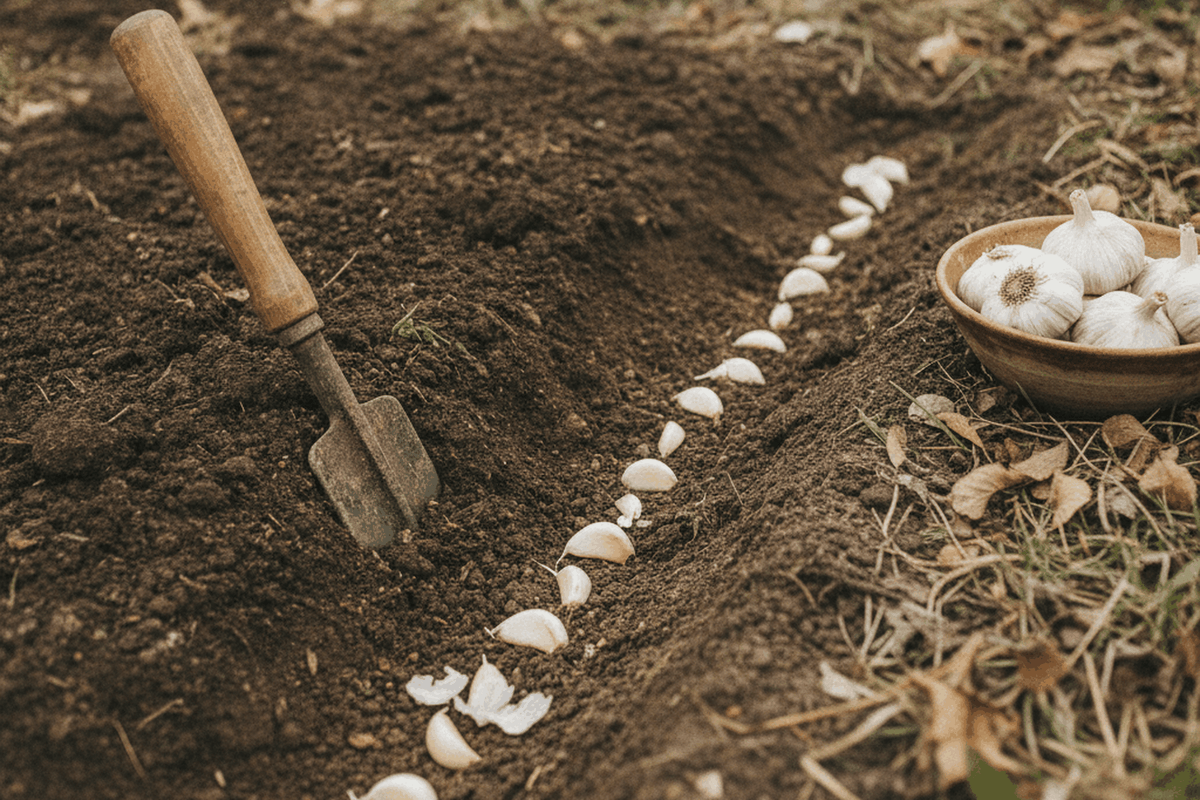
Loosen the bed and work in compost, break the bulbs apart on planting day, sort out the biggest cloves, then set each one pointed end up at the depth your winter calls for, six inches apart. Firm the soil, water once and mulch. It is one afternoon in October, in the order that goes quickest.
Step 1. Loosen the bed and work in compost
Dig the bed over to at least a spade's depth and mix in two to three inches of finished compost. Garlic spends nine months in whatever you leave it, and this is the last easy chance to fix the soil. If the ground holds water, mound the row above grade.

A digging spade opens and turns a bed faster than a fork in heavier ground, and cuts cleanly through roots crept in from the edges. Our D-handle garden spade is double-patented, with a blade curved to carry soil and drawn to a point to cut. It takes up to 80% less effort than a standard shovel.
Step 2. Break the bulbs apart on planting day
Separate bulbs into cloves the day you plant, not the week before. The papery skin is a clove's only protection, and cloves cracked early dry out at the exposed base. Leave the skin on.
Step 3. Sort the cloves and plant only the biggest
Clove size predicts bulb size more directly than anything else you control. Plant the large outer cloves, cook the small inner ones, discard any that are soft or bruised.
Step 4. Set each clove pointed end up
The pointed end is the shoot and the flat scarred end is the root plate, so the point goes up. A clove planted upside down usually grows, but it wastes energy turning itself around and makes a smaller bulb.
Step 5. Plant at the depth your winter calls for
One to two inches deep where the ground rarely freezes, two through the middle of the country, three where winters are hard, measured from the soil surface to the base of the clove.
Step 6. Space the cloves and close the trench
Set cloves six inches apart in the row, twelve between rows. Firm the soil back so there are no air pockets against the clove, then water once.
Step 7. Mulch three to six inches deep
Cover the bed with straw or shredded leaves. University of Minnesota Extension recommends three to four inches of leaf or straw mulch to keep winter soil temperatures from swinging, and going to the deep end of that or a little beyond makes sense where winters are hard and snow cover is thin. Mulch also stops frost heave, holds moisture and suppresses the spring weeds that would outcompete a crop that cannot shade them out.
Then stop. Garlic asks for nothing until spring, and these are the same beds in our garden winterizing checklist.
What does garlic need through the season?
Through fall and winter, nothing. Leave the mulch and let the bed freeze. In cold regions leave it through spring and let shoots come up through it; in wet or mild regions pull it back so the soil is not held saturated. Shredded leaves work as well as straw, which is a good argument for mulching your leaves.
Spring is where the crop is made. Feed nitrogen early, from first shoots through about the beginning of May in the north, because every leaf built before bulbing becomes a wrapper. Then stop: nitrogen once bulbing starts pushes soft growth that stores poorly.
Water about an inch a week while the plants grow hard, and weed relentlessly. Garlic has narrow upright leaves and cannot shade anything out, so it loses to weeds more easily than anything else in the bed. Yellowing lowest leaves in late spring is normal.
If you planted hardneck, scapes appear in early summer as a curling stem. Snap them off at one full curl. Left on, they divert energy into a flower head instead of the bulb: Clemson Cooperative Extension puts the cost of leaving them at an average 30 percent reduction in bulb size, and Oregon State and Penn State Extension both advise removing them to increase bulb size. They are also excellent cooked, which makes this the one chore that pays twice. Stop watering once the lower leaves yellow and the tops begin to fall, which is what Arizona Cooperative Extension advises to keep the bulbs from rotting at the end.
How long does garlic take to grow?
About eight to nine months from a fall planting. An October clove is lifted the following July, so garlic occupies the bed longer than anything else you grow. Southern gardens run shorter, closer to seven months, because they plant later and harvest in late May or June. Spring-planted garlic takes four to five months and gives smaller bulbs.
Roots grow through October and November, then the plant sits dormant. Shoots emerge in March or April, hardneck scapes curl in June, harvest lands in July. The plants reach eighteen to thirty six inches tall, and everything you are growing happens out of sight below them.
When is garlic ready to harvest, and how do you cure it?
Harvest in July, when the lower leaves have browned but half or slightly more than half of the upper leaves are still green. That is University of Minnesota Extension's rule, and it puts the harvest between late June and late July. Then cure the bulbs for weeks, not days, before you trim or store them.
Waiting for all the leaves to brown is the classic mistake: the wrappers break down in the ground, the bulb splits, and a crop that should have kept until spring will not keep until Thanksgiving. Oregon State University Extension goes further and warns not to read the leaves at all, because bulbs are sometimes ready while the tops are still green. Dig one test bulb first, and if the cloves fill the wrapper and the divisions show through the skin, it is ready.
Loosen the soil beside the row with a fork and lift the bulbs rather than pulling the stems, which snap. Do not wash them and do not leave them in direct sun, which scalds the wrappers within an hour on a hot day.
Cure in a warm, dry, airy place out of direct sun, hung in bunches or laid on a rack. University of Minnesota Extension calls for three to four weeks; Clemson and Cornell both land at two to three, so treat dry necks and papery wrappers as the finish line rather than the calendar. Once they are cured, trim the roots and cut the stems, or braid the softnecks. Store somewhere dark, dry and well ventilated, and keep the bulbs out of the refrigerator, because Oregon State University Extension notes that moisture and cool temperatures trigger sprouting. Set your largest bulbs aside for replanting first.
What goes wrong with garlic, and how do you avoid it?
Most garlic failures trace to one of eight things, and six of the eight are decided at planting. Small cloves, crowding, ground that stays wet over winter, planting too shallow, planting too late in spring and the wrong garlic for your zone all set a ceiling on the crop before a single leaf appears.
| What you see | What it is | What to do |
|---|---|---|
| Nothing comes up in spring | Cloves rotted over winter in wet ground | Plant into a mounded row or raised bed next time |
| Cloves sitting on the surface after a thaw | Frost heave | Plant deeper and mulch four to six inches |
| Golf ball bulbs in July | Small cloves planted, crowding, or weeds | Plant only large cloves at six inches, weed early |
| One fat undivided round | Not enough cold to trigger division | Plant in fall so the cloves get a full winter; in mild zones plant softneck |
| Wrappers burst, cloves separating | Harvested too late | Lift when half the leaves are still green |
| Missing cloves, tunnels under the mulch | Voles working under cover | Pull mulch back from the crowns, set traps early |
| Orange specks on the leaves | Garlic rust | Improve airflow, rotate, do not compost the tops |
| White fluff at the base, plants collapse | White rot | Remove the plants, never move that soil or those bulbs |
Two deserve more than a table row. Voles are why a bed that looked perfect in November can be half empty in April: the mulch you laid for the garlic is excellent vole habitat and they work the row from underneath all winter. Pull it back from the crowns and deal with the population early, which is what our guide to mole and vole repellents is for. White rot is the one to take seriously: a soil fungus that persists for decades and has no home cure. Bag affected plants and never move that soil.
The single most common mistake is harvesting too late. The plant looks alive, the leaves are still standing, and every week past the half-green mark costs storage life.
Tools for this job
The few things this job calls for, from breaking the bed in fall to lifting the bulbs in July.

Spear Head Spade 40 inch D-Handle Garden Spade
Turns and breaks up the garlic bed faster than a fork in heavier ground and cuts cleanly through any roots that have crept in from the edges.
Fiskars Bulb Transplanter with depth markings
Depth markings on the blade make it easy to set every clove at the two to four inch depth your winter calls for.
Check price on AmazonHealthiStraw GardenStraw, 3 cubic feet
A clean bagged straw for the four to six inch mulch layer that moderates soil temperature, stops frost heave and holds back spring weeds.
Check price on AmazonRadius Garden PRO digging fork
Loosens the soil beside the row at harvest so you can lift bulbs whole instead of pulling on stems that snap.
Check price on AmazonHardneck seed garlic for planting
If you do not have a local grower, look for hardneck seed garlic sold for planting rather than eating and pick a named variety suited to your zone.
Check price on AmazonFrequently asked questions
When should you plant garlic?
In mid fall, once the soil has cooled and well before the ground freezes. That is late September to mid October in zones 3 and 4, October in zones 5 and 6, late October into November in zones 7 and 8, and October through December in zones 9 and 10.
How deep do you plant garlic?
One to two inches deep where the ground rarely freezes, two through the middle of the country, three where winters are hard, measured from the soil surface to the base of the clove. University of Minnesota Extension puts the base of the clove two to three inches from the soil surface. The extra depth protects against frost heave.
How far apart should garlic be planted?
About six inches between cloves with rows roughly twelve inches apart. Garlic holds the bed for nine months, so crowding costs bulb size. Large hardneck varieties earn eight inches.
Which end of the garlic clove goes down?
The flat scarred end goes down and the pointed end goes up. The flat end is the root plate, the point is the shoot. A clove planted upside down usually grows, but it makes a smaller bulb.
Should you soak garlic before planting?
It is optional, and the purpose is sanitation rather than size. A University of California Master Gardener column suggests an overnight soak in water with about a teaspoon of baking soda per quart to kill bacteria on the cloves. University of California IPM lists a hot water dip and a soap and mineral oil soak specifically against bulb mites, and notes the hot water treatment can also reduce germination. Nothing supports soaking making bulbs bigger on clean seed, so skip it unless your seed came from a swap or a troubled bed.
Can you plant garlic from the grocery store?
You can, but it usually disappoints. Supermarket garlic is often treated to resist sprouting, is typically a softneck that may not suit a cold climate, and can introduce allium diseases to your soil. Seed garlic from a grower is the better buy, and you replant your own after the first year.
When is garlic ready to harvest?
When the lower leaves have browned but half or slightly more than half are still green, usually in July. Leaving it until all the leaves brown lets the wrappers deteriorate and the bulbs split, which ruins storage life.
The bottom line
Plant in October, plant the biggest cloves you have, get the depth right for your winter, and mulch deeply. The rest is waiting, one round of weeding, and lifting the bulbs in July while half the leaves are still green.
Disclosure: some links in this guide are affiliate links to Amazon. This is at no extra cost to you, and it never changes our honest, use-based recommendations.
Product prices and availability are accurate as of the date/time indicated and are subject to change. Any price and availability information displayed on Amazon.com at the time of purchase will apply to the purchase of this product.