As an Amazon Associate we earn from qualifying purchases. Some brands also pay us when you click or buy, so those links are ads. Full disclosure below
The best lawn sweeper for most yards is the Agri-Fab 44 inch tow-behind, which pairs the widest sweep here with a 28 cubic foot hopper. For a quarter to half an acre, the Brinly LS2-42BH sweeps 42 inches into a 20 cubic foot hamper. Under a quarter acre, the 26 inch VEVOR Classic push sweeper is all you need.
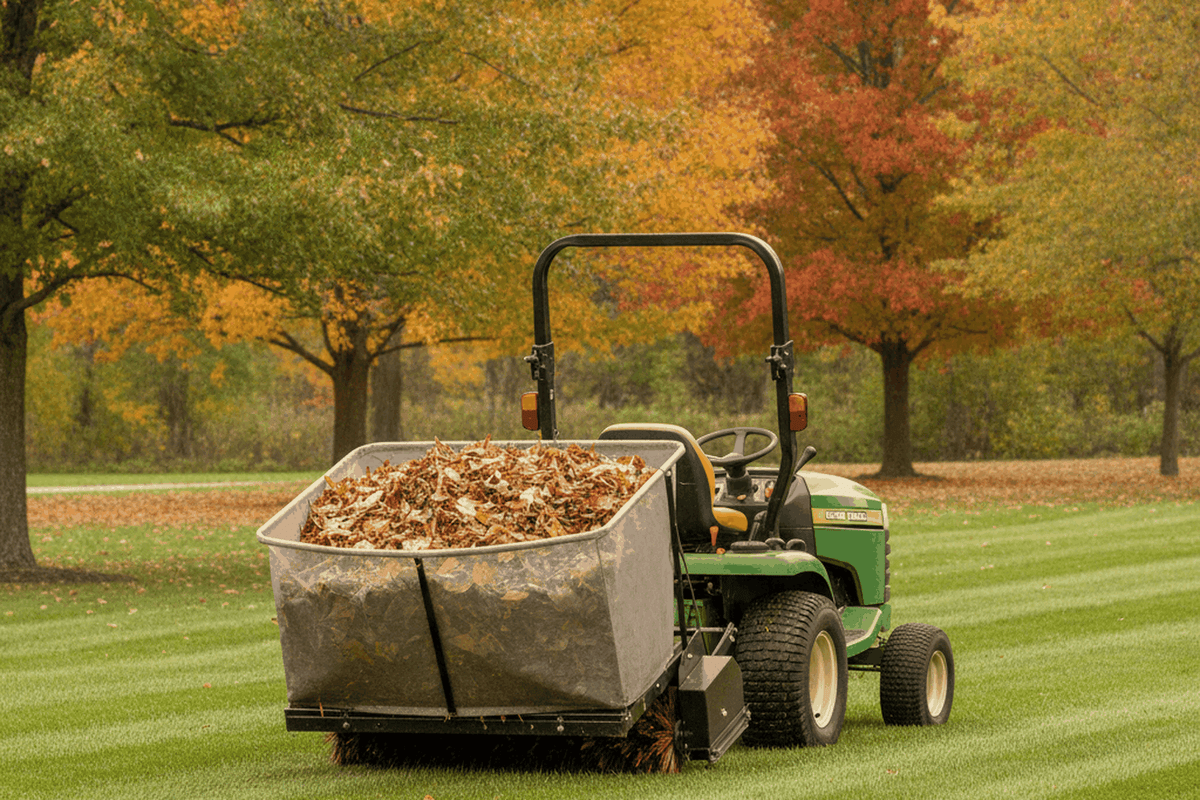
A lawn sweeper is a mechanical rake with no engine in it. The wheels turn a brush shaft through a gear set, usually between 4.5 to 1 and 5.6 to 1, so the bristles spin several times faster than the ground passes under them and flick leaves, clippings, and pine needles back into a hopper. This page is one stop on our fall yard cleanup tools checklist, which puts every fall job in order.
That gearing is also why technique decides whether a sweeper looks brilliant or useless. Tow at a steady 3 to 5 miles per hour: crawling starves the brushes of tip speed, racing leaves stripes. Set the brush height so the bristles just kiss the canopy, about half an inch in, since burying them wears bristles and drags the tractor. And sweep dry. Wet leaves clump and ride over the brush instead of lifting, the one complaint every sweeper in this class shares.
Timing follows leaf drop, not the calendar, and the point is to keep a wet mat off the grass, because packed leaves block light and hold moisture against the crown, which is how snow mold starts. Penn State Extension puts the useful limit at a shredded layer up to about half an inch deep; past that it has to come off, and our guide to mulching leaves with the mower covers where that line falls on your lawn.
One thing before the list: we make digging tools, not lawn sweepers, so nothing here is ours. Each pick is judged on sweep width, hopper volume, brush-to-wheel ratio, and what the listing actually states.
Best lawn sweepers at a glance
| Pick | Type and width | Hopper | Brush-to-wheel ratio | Best for | Our verdict | Where to buy |
|---|---|---|---|---|---|---|
| 1. Agri-Fab 44 in Tow-Behind Lawn SweeperBest lawn sweeper overall | Tow-behind, 44 in | 28 cu ft | 5.6 to 1 | Half an acre and up | The widest and highest capacity sweeper here, with a dump-from-seat handle that empties it without leaving the seat, the feature you feel most on a big property. | Check price on Amazon |
| 2. Brinly LS2-42BHBest tow-behind for a quarter to half acre | Tow-behind, 42 in | 20 cu ft | 5 to 1 | A quarter to half an acre | The one to buy if the Agri-Fab is more sweeper than your lawn deserves, with a twist-lock height adjuster that holds its setting over rough ground. | Check price on Amazon |
| 4. Brinly 42 in Combo Sweeper with DethatcherBest two-in-one | Tow-behind, 42 in | 20 cu ft | Not listed | Sweep and dethatch in one pass | Two rows of flexing tines ahead of the same 42 inch, 20 cubic foot sweeper as the LS2, so it pulls thatch up and collects it in one pass instead of two. | Check price on Amazon |
| 5. VEVOR Classic Push Lawn Sweeper, 26 inBest push sweeper for small yards | Push, 26 in | 7 cu ft | 5 to 1 | Under about a quarter acre | For a small lot it is the right answer rather than a compromise, with four spinning brushes and a tool-free brush height knob. | Check price on Amazon |
| 6. YINTATECH 42 in Tow-BehindTow-behind with a full mesh cover | Tow-behind, 42 in | 20 cu ft | Not listed | A covered hopper that folds small | A full-enclosure mesh cover keeps sticks and stones from flying out, though the listing does not state a brush-to-wheel ratio. | Check price on Amazon |
What is the best lawn sweeper?
The Agri-Fab 44 inch. It is the widest sweep in this group, and the listing puts the flow-through hopper at 28 cubic feet, filling back to front, with a 5.6 to 1 brush-to-wheel ratio, adjustable brush height, and a dump-from-seat handle. It is also the most expensive tow-behind here.
Buy it if you clear half an acre or more of leaves every fall, because width and hopper volume decide how long you sit on the tractor. For a quarter to half an acre, the Brinly LS2-42BH gives you 42 inches and 20 cubic feet.
One honest caveat. Agri-Fab also sells a 50 inch heavy duty sweeper with a 26 cubic foot hopper, and it costs less than the 44 for six more inches of sweep. The listing states four 10 inch brushes, a solid brush shaft that drives all of them evenly through turns, and toolless single lever height adjustment, but no brush-to-wheel ratio. The tradeoffs are two cubic feet less hopper and 58 inches of overall width to store. Past about two acres the wider deck wins. Under that, the 44 keeps the bigger hopper and the highest published ratio here.
What should you look for in a lawn sweeper?
Five specs separate these machines, and only three show up in the marketing.
- Sweep width sets your number of passes. Tow-behinds run 42 to 50 inches, push models 21 to 26. Match the sweeper to your mower deck or go wider, so one sweep pass covers one mow pass.
- Hopper volume sets your number of stops. Dry leaves are bulky and weightless, so you empty on volume, not weight. Twenty cubic feet is the tow-behind standard, 28 is the biggest here, and a 7 cubic foot push hopper fills three or four times on a small lawn.
- Brush-to-wheel ratio decides pickup. It is the least advertised number and the one that matters most. Higher ratios spin the bristles faster at a given ground speed, which is what lifts a flat leaf off turf. The picks here that state one run 4.5 to 1 up to 5.6 to 1.
- Height adjustment should lock. Pavement, short grass, and a leaf-covered lawn all want different settings, and the setting has to hold over bumps. Twist-lock and indexed adjusters do that.
- Storage. A sweeper is a wide, awkward thing you use four weeks a year. Folding drawbars and upright hampers are worth real money.
Tow-behind or push: which lawn sweeper do you need?
| Lawn size | Type | Sweep width |
|---|---|---|
| Under a quarter acre | Push | 21 to 26 in |
| Quarter to half acre | Tow-behind | 42 in |
| Half acre and up | Tow-behind | 42 to 44 in |
| Two acres and up | Tow-behind, wide deck | 50 in |
| Heavy thatch, any size | Combo with dethatcher | 42 in |
The honest cutoff is walking distance. A 26 inch push sweeper covers a quarter acre in about a mile of walking, a pleasant hour. On a half acre that is two miles behind a hopper you empty every few minutes, which is where people quit and go back to the rake.
Which push lawn sweeper is best?
The VEVOR Classic 26 inch, on the condition that the lawn is small. It sits at the top of the push range at 26 inches, holds 7 cubic feet, and drives four spinning brushes at a 5 to 1 brush-to-wheel ratio, with a tool-free knob for brush height. Two things decide whether a push sweeper feels like a bargain or a mistake. The first is stops: plan on emptying three or four times on a quarter acre of dry leaves, because 7 cubic feet fills fast. The second is pace. The brushes are geared to the wheels, so a slow stroll does not spin them fast enough to lift a flat leaf off the turf, and a brisk, even walk picks up material a dawdling pass leaves behind. On a half acre, on slopes, or on a lawn that sheds in heavy waves, the money is better spent towing.
Lawn sweeper, bagger, or leaf vacuum: which is faster?
| Tool | How it works | Best on | Weak spot |
|---|---|---|---|
| Lawn sweeper | Geared brushes flick debris into a hopper | Open turf, clippings, needles | Wet mats, beds, corners |
| Mower bagger | The deck cuts and blows into bins | Light loads while you mow | Small bins, constant stops |
| Leaf vacuum and mulcher | An engine shreds debris into a bag | Beds, corners, leaves for compost | Slow over acreage, hose work |
| Leaf blower | Air moves leaves into piles | Driveways, beds, fence lines | Collects nothing on its own |
Over open lawn a tow-behind sweeper is the fastest of the four, because it collects at mowing speed and holds ten times what a bagger bin does. It is also the worst of the four anywhere it cannot drive. Sweeper owners still keep a good leaf rake and a cordless blower for edges, and for leaves shredded down for compost a leaf vacuum and mulcher is the better second machine. A backpack leaf blower or, on a big property, a walk behind leaf blower windrows the leaves for the sweeper to pick up.
When should you sweep, by region?
- North and upper Midwest. Early October to mid November. Finish before the ground freezes, since anything left under snow comes out matted in spring.
- Transition zone, Virginia through Kansas. Late October into early December. Oaks hold their leaves late, so plan on two or three sweeps.
- South and Gulf. Waves from November into winter, plus pine straw most of the year. A sweeper earns its keep on needles, which blowers scatter.
- Before you feed or seed. Sweep first, then put down your fall fertilizer, because granules that land on leaves never reach the soil. Same order for dethatching, which throws a startling amount of material up for the sweeper, and for core aeration, where clear turf lets the tines reach soil instead of leaf litter.
The best lawn sweepers, by job
Two things separate these six: whether you tow or push, and how often you stop to empty.
1. Agri-Fab 44 in Tow-Behind Lawn Sweeper: best lawn sweeper overall
Best lawn sweeper overall
Best for: Half an acre and up
Agri-Fab 44 in Tow-Behind Lawn Sweeper
- Type and width: Tow-behind, 44 in
- Hopper: 28 cu ft
- Brush-to-wheel ratio: 5.6 to 1
The widest and highest capacity sweeper here, with a dump-from-seat handle that empties it without leaving the seat, the feature you feel most on a big property.
The Agri-Fab 44 inch is the widest and highest capacity sweeper here, and the listing backs both numbers up: a 28 cubic foot flow-through hopper bag that fills from back to front, a 5.6 to 1 brush-to-wheel ratio, adjustable brush height, bronze brush shaft bushings, and 12 by 3 inch tires. The dump-from-seat handle is the feature you feel most on a big property, because emptying without leaving the seat is the difference between four stops and four dismounts. Agri-Fab rates the hopper at up to twice the capacity of a traditional three-bin bagger, which is the comparison most buyers are actually making. Where it loses: it is the priciest tow-behind on this list, 44 inches is a lot of machine to store, and like every sweeper it will disappoint you on soaked leaves.
2. Brinly LS2-42BH 42 in Tow-Behind: best value tow-behind
Best tow-behind for a quarter to half acre
Best for: A quarter to half an acre
Brinly LS2-42BH
- Type and width: Tow-behind, 42 in
- Hopper: 20 cu ft
- Brush-to-wheel ratio: 5 to 1
The one to buy if the Agri-Fab is more sweeper than your lawn deserves, with a twist-lock height adjuster that holds its setting over rough ground.
The Brinly LS2-42BH is the one to buy if the Agri-Fab is more sweeper than your lawn deserves. You get a 42 inch sweep, a 20 cubic foot hamper with a pull cord and T-handle for emptying, six high-velocity brushes on a 5 to 1 gear ratio, a twist-lock height adjuster that holds its setting over rough ground, a removable mesh windscreen, and a universal hitch pin. Collapsible braces let the hamper store upright. Brinly sells this sweeper in two finishes, Hammered Black (LS2-42BH-G) and Hammered Gunmetal (LS2-42BH-S), and its own product pages list the same specifications for both; our link goes to the black. Where it loses: its hamper holds 20 cubic feet to the Agri-Fab's 28, with two inches less sweep, so on half an acre or more of heavy drop you stop to empty more often.
3. Ohio Steel 4222V2: for heavy leaf volume and repeat passes
The Ohio Steel 4222V2 splits the difference at 42 inches and 22 cubic feet, and its distinguishing feature is the brush design: 11 inch spiraled polypropylene brushes, which Ohio Steel lists as a patented exclusive, on a 4.5 to 1 ratio with 11 inch semi-pneumatic wheels and sealed ball bearings on the brush axle. The drawbar offsets left or right, so you can sweep and mow in the same trip. Drawbar and bag both fold for storage, and the listing claims 30 minute assembly with one tool. Where it loses: it has the lowest brush ratio of the first three picks, and the offset drawbar only helps if your mower discharges to the side you set it up for.
The Ohio Steel 4222V2 was out of stock on Amazon when we checked on October 12, October 13 and October 27, 2026, so we do not link it for now. Until it is back, pick 1, the Agri-Fab 44 inch, is the bigger hopper for leaves that come down in waves.
4. Brinly 42 in Combo Sweeper with Dethatcher: best two-in-one
Best two-in-one
Best for: Sweep and dethatch in one pass
Brinly 42 in Combo Sweeper with Dethatcher
- Type and width: Tow-behind, 42 in
- Hopper: 20 cu ft
- Height positions: 10, locking
Two rows of flexing tines ahead of the same 42 inch, 20 cubic foot sweeper as the LS2, so it pulls thatch up and collects it in one pass instead of two.
The Brinly 42 inch combo hangs two rows of 12 independently flexing tines ahead of the same 42 inch, 20 cubic foot sweeper as the LS2, so it pulls thatch up and collects it in one pass instead of two. A side control gives 10 locking height positions, the tines lock rear-facing for transport or sweeper-only mode, and a magnetic quick-connect hitch pin stays put without a cotter pin. It folds vertically for storage, and the sweeper half is the same 42 inch unit as the LS2 rather than a compromise built around the tines. Where it loses: it is the most expensive machine here, and the tines add a job most lawns need once a year at most. If you are dethatching seriously, a dedicated unit from our dethatcher guide costs less and pulls harder.
5. VEVOR Classic Push Lawn Sweeper, 26 in: best push sweeper for small yards
Best push sweeper for small yards
Best for: Under about a quarter acre
VEVOR Classic Push Lawn Sweeper, 26 in
- Type and width: Push, 26 in
- Hopper: 7 cu ft
- Brush-to-wheel ratio: 5 to 1
For a small lot it is the right answer rather than a compromise, with four spinning brushes and a tool-free brush height knob.
The VEVOR Classic 26 inch push sweeper is the entry point to the whole category, and for a small lot it is the right answer rather than a compromise. It sweeps a 26 inch path with four spinning brushes geared to the wheels at a 5 to 1 ratio, holds 7 cubic feet in a durable hopper bag, and sets brush height with a tool-free knob. The bag detaches quickly for dumping, and the frame is metal rather than plastic. VEVOR lists it as the 26 inch Classic, model GT1110. Where it loses: like every sweeper here, it struggles on wet leaves, the 7 cubic foot bag means frequent stops, and everything past a quarter acre turns into a long walk.
6. YINTATECH 42 in Tow-Behind: best budget tow-behind
Tow-behind with a full mesh cover
Best for: A covered hopper that folds small
YINTATECH 42 in Tow-Behind
- Type and width: Tow-behind, 42 in
- Hopper: 20 cu ft
- Storage: Folds to about 30 percent of its size
A full-enclosure mesh cover keeps sticks and stones from flying out, though the listing does not state a brush-to-wheel ratio.
The YINTATECH 42 inch gets you towing for less than any other tow-behind here. It sweeps 42 inches into a 20 cubic foot hopper, adds a full-enclosure mesh cover that keeps sticks and stones from flying out, and empties with an offset dumping rope you pull from the seat. Brush height adjusts up to 2 inches, with the lowest setting putting the bristles about half an inch into the grass, and the whole thing folds to about 30 percent of its size. Where it loses: the listing does not state a brush-to-wheel ratio, which is the spec that separates good pickup from mediocre, and parts and service on a newer brand are a thinner bet than Agri-Fab, Brinly, or Ohio Steel.
Which lawn sweeper is best for leaves?
For leaves specifically, buy hopper volume rather than sweep width. Width sets how many passes you make, but dry leaves are bulky and almost weightless, so what drags the job out is how often you stop to empty. On half an acre or more of heavy drop, the Agri-Fab 44 inch and its 28 cubic foot hopper is the pick. If your leaves come down in waves and you will sweep the same lawn three or four times, the Ohio Steel 4222V2 at 22 cubic feet is built for that, but it was out of stock on Amazon when we checked on October 12, October 13 and October 27, 2026; until it is back, the Agri-Fab's 28 cubic feet covers repeat passes too. Under a quarter acre with no tractor, the VEVOR Classic push sweeper handles leaves fine as long as you accept emptying it every few minutes.
Two habits matter more than the machine. Sweep the leaves dry, because a damp mat rides over the brushes instead of lifting off the turf. And overlap each pass slightly instead of crossing your own tracks at right angles, so the bristles keep meeting leaves that are sitting on top of the canopy rather than ones already pressed down into it. If the drop is deep enough to hide the grass, windrow it with a blower first and sweep the rows, since the brushes lift a two inch pile far better than a six inch one.
What comes out of the hopper is worth keeping. A sweeper collects leaves clean, without the gravel and grit a rake drags along, so they go straight into a compost bin or a corner pile and come back as leaf mold next spring.
How to choose a lawn sweeper
- Tractor first. If you own a lawn tractor or zero-turn, buy a tow-behind. If not, buy a push sweeper and cap its lawn at about a quarter acre.
- Buy hopper, not width. Two extra inches of sweep saves a pass. Eight extra cubic feet saves a stop, and stops make the job feel long.
- Check the ratio before the color. Anything at 5 to 1 or better lifts flat leaves off turf. A listing that omits the ratio is an unknown, not a good number.
- Measure your storage. A 42 inch sweeper that folds upright fits a garage corner. One that does not lives outside, and hopper fabric hates that.
Frequently asked questions
Do lawn sweepers really work?
Yes, on dry material over open lawn, which is the job they are built for. The brushes are geared to spin four to six times faster than the wheels, so they lift leaves, clippings, and pine needles into the hopper at mowing speed with no engine and no bending. They do not work well on soaked leaves or in beds and corners, so most owners keep a rake or blower for the edges.
Do lawn sweepers work better than raking?
On open lawn, yes, and not by a small margin. A 42 inch tow-behind collects at mowing speed a strip that takes several minutes to rake by hand, and it does the work without loading your back and wrists. A rake still wins in planting beds, along fences, on slopes, and on wet matted leaves, which is why most sweeper owners keep one.
Will a lawn sweeper pick up wet leaves?
Poorly. Wet leaves clump and stick to the turf, so the brushes ride over the mat instead of flicking it up, and damp debris packs into the bristles. Wait for a dry afternoon, raise the brush height a notch so the bristles are not dragging, and go slower than usual. If wet leaves are your normal fall, a leaf vacuum and mulcher handles them better than any sweeper.
What size lawn sweeper do I need?
Match it to your lawn and your equipment. Under about a quarter acre, a 21 to 26 inch push sweeper with a 7 cubic foot hopper is enough. From a quarter to half an acre, a 42 inch tow-behind with a 20 cubic foot hopper is the sweet spot. At half an acre and up, go to 44 inches and 28 cubic feet so you make fewer passes and fewer stops to empty. Past about two acres, 50 inch decks sweep wider for close to the same money.
Can a lawn sweeper pick up pine needles?
Yes, and needles are one of the jobs a sweeper does better than anything else. Blowers scatter them, rakes tangle in them, and mowers chop them without collecting. Spinning brushes comb needles out of the canopy and into the hopper. Expect them to pack denser than leaves, so the hopper gets heavy sooner than its volume suggests.
Will a lawn sweeper pick up sticks and acorns?
The small stuff, yes. Twigs up to about pencil thickness, acorns, sweet gum balls, and small pine cones get flicked into the hopper along with the leaves, and a mesh cover keeps them from bouncing back out. Pick up anything longer than a foot or thicker than your thumb first, because long sticks wrap around the brush shaft and stall it and a hidden rock chips bristles. Walking the lawn once before the first sweep of the season is what makes a sweeper last.
Do lawn sweepers pick up grass clippings?
Yes, and it is the job they do most often outside of leaf season. Dry clippings lift easily, so a sweeper is a practical stand-in for a bagging deck after the first cut of spring or any time the lawn got away from you. Wet clippings are the exception: they mat, pack into the bristles, and are better left on the lawn anyway, where they return nitrogen to the soil.
Is a lawn sweeper better than bagging with the mower?
For volume, yes. A mower bagger holds two or three cubic feet and needs the deck running, while a tow-behind hopper holds 20 to 28 cubic feet and works whether you are mowing or not. The bagger wins on light loads and on small lawns, where a second machine is not worth hauling out.
The bottom line
Tractor and half an acre or more of leaves: buy the Agri-Fab 44 inch. For a quarter to half an acre the Brinly LS2-42BH sweeps 42 inches into a 20 cubic foot hamper, and the YINTATECH tows on a tight budget. Small lot, no tractor: the VEVOR Classic push sweeper. Sweep dry, keep the brushes just off the soil, and empty before the hopper packs. The rest of the fall list is in our garden guides.
A word on who wrote this: we are Spear Head Spade, a family business in New Jersey. We sell double-patented spades and one long-handled hoe, with over 600,000 sold. A hopper of leaves is next spring's soil, and when it goes back into a bed our spade finder matches a spade to your height and your ground.
Disclosure: Our commissions do not change what we recommend or what you pay.
Product prices and availability are accurate as of the date/time indicated and are subject to change. Any price and availability information displayed on Amazon.com at the time of purchase will apply to the purchase of this product.