As an Amazon Associate we earn from qualifying purchases. Some brands also pay us when you click or buy, so those links are ads. Full disclosure below
The best landscape edging for most flower beds and lawn borders is steel, and the choice within steel comes down to one number most listings bury in the small print: how deep it goes. A typical hammer-in kit puts about three inches in the ground. A six inch Cor-Ten strip is tall enough to go twice that deep, and depth is what actually holds grass back.
Worth saying plainly before the list starts: edging does not have to be a product. The oldest and best looking border in landscaping is a trench cut into the soil with a spade, and it is what most of the estate gardens you have admired actually use. Everything else on this page is a way to make that line hold with less maintenance.
Which is the real decision. University of Illinois Extension puts it plainly: grass grows toward and into beds about three to four inches a year. So the honest question is not "which edging works" but how much of that creep you are willing to fight, and how often. A trench edge asks for twenty minutes once or twice a season. Six inches of steel asks for almost nothing for twenty years, and asks for an afternoon of hammering up front.
One thing before the list: we make digging tools, so the spade in idea one is ours and we say so. Every edging material below is somebody else's product.
How we chose: every product here was checked against its live listing on the day of writing. Where a material's behavior is a horticultural question rather than a spec, we cite university extension sources rather than guess. For the metal kits we also read the makers' own pages where one exists. Where a spec is not on the listing, we say so instead of filling it in.
Landscape edging ideas at a glance
| Material | Buries | Best for | Where to buy |
|---|---|---|---|
 Spade-cut trench edge (best looking)
 |
As deep as you cut | Natural, curved, informal beds | Our D-handle spade |
| Galvanized steel strip (low-profile steel) | 3 in, 2 in showing | A crisp, low-profile steel line | Amazon, 33 ft |
| Cor-Ten steel, 6 in strip (best barrier) | Up to 6 in, driven to the rolled top | Buying it once and never revisiting it | Amazon, 48 in strip |
| Cor-Ten steel six-pack | Not stated, 6 in tall | The rusted patina look, no stated depth | Amazon, 20 ft |
| Aluminum | Not stated | Wet ground and coastal yards | Amazon, 24 ft |
| No-dig plastic coil (easiest to move) | 2 in profile, no trench | Renters, first beds, tight curves | Amazon, 40 ft |
| Pound-in poly | 4.5 in profile | Mowing straight over the border | Amazon, 20 ft |
| Composite | 3 in of a 4 in wall | Depth without metal in the garden | Amazon, 40 ft |
| Recycled rubber | Sits on the surface | Rocky ground where steel will not drive | Amazon, six 48 in sections |
| Edging stones, stone-look poly | Taps in, no digging | The scalloped stone look, shipped | Check price on Amazon |
| Wood log roll | Staked behind | Short cottage accents, not long runs | Amazon, a 47 in roll |
| Brick edging | Trench plus base | Formal flower beds you mow along | Local yard by the pallet |
| Natural stone | Set into the soil | Cottage and rustic borders | Local stone yard by the ton |
| Poured concrete curbing | Footing, contractor set | Permanent, zero maintenance | Local installer |
What is the best landscape edging?
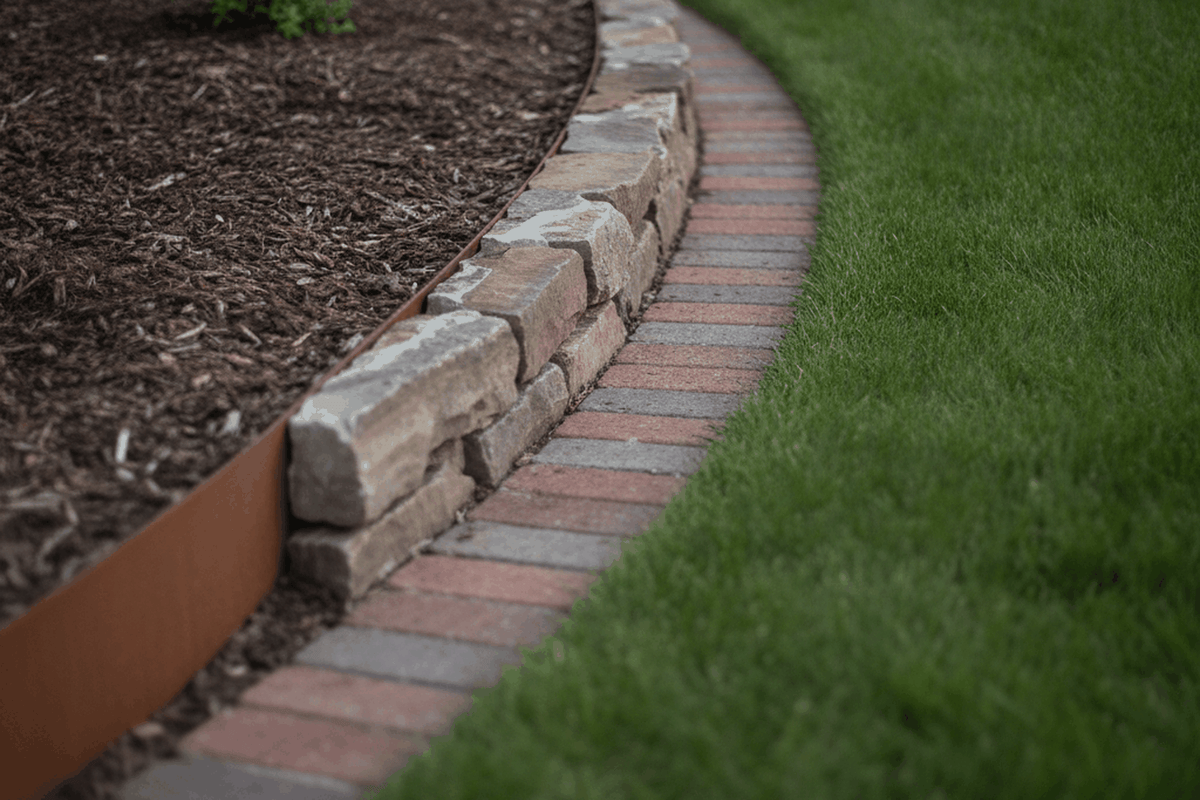
Steel, for most yards. Metal landscape edging is the one material that is at once thin enough to disappear, stiff enough to hold a straight run, and flexible enough to take a curve, and a buried steel strip lets you push mulch right up to the line. Within steel, read the depth before anything else. Most hammer-in kits put only about three inches in the ground, and University of Illinois Extension puts the depth that easily contains bluegrass at four inches, so three inches slows grass rather than stopping it. The Edge Right Cor-Ten strip is six inches tall in 16-gauge steel by the maker's own site, tall enough to be driven well past that threshold, and the only metal kit here with a stated gauge.
The short answer, by job:
- Best landscape edging overall: six inch Cor-Ten steel, for a border you install once and leave alone.
- Best lawn edging to mow along: a flat-top pound-in border set level with the turf, or brick laid flat.
- Best for wet ground and coastal yards: aluminum, which cannot rust.
- Best for rocky soil: recycled rubber, which does not have to be driven.
- Best for a bed you will redraw next year: no-dig plastic coil.
- Best looking, with no product at all: a spade-cut trench edge.
What should you look for in landscaping edging?
Five things separate edging that holds for a decade from edging that heaves out of the ground in the second spring.
- Buried depth is what actually stops grass. Height above grade is cosmetic. What blocks turf is the part below the soil line, because grasses spread by rhizomes and stolons that travel horizontally a few inches down. University of Illinois Extension puts the threshold at four inches, noting that an edge four inches deep and wide can easily contain bluegrass. Aggressive spreaders are a different story: bermudagrass rhizomes are usually in the top one to six inches but have been recorded far deeper, and quackgrass shoots come up from rhizomes at ten inches or more, which is why no edging is a permanent fix against either.
- The top profile decides whether you can mow it. A flat top set level with the turf lets a mower wheel ride straight over the border and cuts your string-trimming to nothing. A rolled or decorative top looks better and commits you to trimming by hand.
- Stake count, not stake length. Frost heave pushes edging up, and stakes are what hold it down. Count the stakes against the footage: the galvanized steel kit ships 11 stakes for 33 feet, the aluminum kit 12 for 24 feet, the composite 24 for 40, the pound-in poly 6 for 20, and the no-dig plastic 50 spiral spikes for 40 because thin plastic needs far more anchoring than steel does. If a kit ships light, a bag of 50 ten inch landscape anchoring spikes fixes it and works for paver restraint, turf, and weed fabric too.
- Thickness and gauge over marketing. Thin steel dents when you catch it with a mower deck and thin plastic goes wavy in July sun. This is the spec listings are quietest about. Gauge, when it is stated at all, is the number to look for: 16-gauge steel is substantially heavier than the unstated stock in most hammer-in kits.
- How it takes a curve. Steel and plastic coil bend freely. Composite and rubber sections bend to a limit and then kink. Brick, stone, and log rolls do not bend at all, so a tight curve becomes a series of short straight facets with gaps that grass finds.
The 13 landscape edging ideas, by job
Ordered by how often they are the right answer, not by price.
1. Spade-cut trench edge: the best looking garden border edging, and free
A trench edge is a V or an L cut into the soil at the bed line: a vertical face on the lawn side, a shallow slope back into the mulch, and no material at all. It is the border every other one on this list is imitating. It follows any curve exactly, costs nothing, never heaves, never fades, and can be moved in an afternoon when you change the bed shape. It is also the only entry here whose depth is entirely up to you, which means it is the only one that can be cut deeper than six inches without buying anything.
What it costs you is a recut, at least once a year and twice if you want it crisp through the whole season. Cutting it is a spade job rather than a shovel job, because you want a straight vertical slice and a lifted wedge, not a scoop. Our D-handle Spear Head Spade is built for that cut: the double-patented blade is pointed and sharpened like a spade but curved like a shovel, so the same tool slices the line, makes the relief cut, and carries the wedge out without you swapping tools. It is also the tool the bed already needs for planting, which is why a trench edge is the only idea here that adds nothing to the shed.
Not sure which of our spades suits your height and soil, take the two minute spade finder. For the technique itself, string line to finished trench, we wrote it up step by step in how to cut and keep a clean bed edge.
2. Galvanized steel: the best low-profile steel landscape edging
The STIRLINGEAR galvanized steel kit is the simplest way to put real metal at a bed line: ten powder-coated black panels, each 40 inches long and 5 inches high, covering 33 feet with 11 hammer-in stakes.
Read the geometry before you buy, because the listing is unusually honest about it and most buyers miss it. Of those 5 inches, roughly 3 go underground and 2 show above the turf. You are getting a clean low-profile line and a shallow barrier, not a deep one. For an ordinary bluegrass or fescue lawn that is on the edge of enough, and it is the easiest crisp steel line on this page. Where it loses: three inches in the ground is not enough against bermudagrass or quackgrass, cut ends and scratches will eventually bloom rust through the galvanizing, and stony soil will fight the stakes. Wear gloves, the edges are sharp by design.
3. Cor-Ten steel at six inches: the best metal landscape edging overall
The Edge Right hammer-in strip is the one product here sold on the number the rest of the page says matters: its Amazon listing calls it 6 inch depth in 14-gauge Cor-Ten steel, sold as a single 48 inch strip, so a 20 foot border is five of them. Edge Right's own site lists its strips at 16 gauge with a rolled top edge. Read that 6 inches as the strip's height, which is how Edge Right's own site sells it, next to the maker's install note: 2 to 3 inches deep in most soils, deeper if you want it. Drive it down until only the rolled top shows and it buries close to twice what the galvanized kit can. The maker says the strips have sharp teeth that slice into grass or soil with a light hammer tap.
Cor-Ten is weathering steel: it rusts deliberately and the rust layer becomes the finish rather than the failure, going warm orange-brown then darkening. That patina forms over roughly six to nine months, and the runoff stains what it touches while it does, so keep it away from pale patio stone and light gravel through the first season. If you want the same look in shorter strips and can live without a stated depth, the STIRLINGEAR Cor-Ten six-pack gives you 20 feet of 40 by 6 inch strips with six stakes.
Also considered: the Edge Right 16-gauge five pack of the same 6 inch strip, currently unavailable on Amazon; it put 20 feet in one box.
4. Aluminum: best for wet ground and coastal yards
The Dreamscape E-Z Edge kit is four slide-together strips of six feet each, 24 feet in all, so a long border takes several kits. What you buy is the one thing steel cannot offer: the aluminum strips will not rust, ever. In salt air or in a bed that sits wet, that is worth paying for.
Two caveats. The 12 anchoring spikes in the kit are steel, so the anchors will corrode long before the edging does. And the listing does not state a buried depth, so treat the depth as unknown rather than assume it matches the six inch strips above. In an average dry suburban bed, galvanized steel does the same visible job.
5. No-dig plastic coil: the easiest landscape edging to move
The Tegarbed no-dig coil is 40 feet of 2 inch flexible plastic border with 50 spiral spikes, and it is the least committal border on this page. No trench: you lay the coil on the line and drive the spiral spikes through it into the soil.
Be clear-eyed about what two inches buys. This is a mulch dam and a visual line, not a serious root barrier, and 50 spikes for 40 feet tells you how much anchoring thin plastic needs. For a rented yard, a first bed, or a border you expect to redraw next year, it is the right amount of commitment.
6. Pound-in poly: best for mowing straight over the border
The EasyFlex pound-in edging gives you a 20 foot coil and 6 anchoring stakes, in a 4.5 inch straight-top profile made from recycled plastic. The straight top is the point. Set level with the turf it becomes a mowing strip, so the outside mower wheel rides on the border and you stop string-trimming that bed entirely, and the listing rates it to withstand string trimmers besides.
Pound-in means you score the soil and drive it down with a rubber mallet rather than opening a trench first, which is far less work than it sounds on soft ground and considerably more on hard clay. Soak the line the day before if your soil is heavy, or read our notes on working with clay soil first.
7. Composite: best depth without metal in the garden
The EasyFlex composite kit is a 40 foot coil with 24 anchoring stakes, and the maker calls it contractor grade. The 4 inch wall is mostly buried: the listing says it installs at least 3 inches in the ground, so what you see is about an inch of dark line over a barrier at the depth that matters. That makes it quietly one of the better buys here, since it puts as much underground as the galvanized steel kit, and it cannot rust or rot.
8. Recycled rubber: best for rocky ground
The EcoBorder L rubber edging ships 24 feet of 3.125 inch tall border with its hardware, and the listing calls it no-dig. Rubber earns its place in one specific yard: the stony one. Steel stakes stop dead on buried rock and thin plastic snaps, while rubber sections sit on the surface and take spikes wherever the soil actually accepts them, so a rocky border becomes possible instead of infuriating. The cost is looks, since rubber stays visibly rubber, and recycled rubber generally lightens with UV exposure.
9. Edging stones: the look most people picture, with a catch
Scalloped and interlocking edging stones are the best selling border material in the country, and they are the reason a lot of people are reading this page. Real concrete scallops are sold by the piece at any local yard, and they are honestly the weakest performer of anything here on the one spec that counts: they sit on the surface, bury almost nothing, and each piece is a straight segment, so a curve becomes a row of gaps that grass walks through in a season.
They are still the right pick when the look is the point and the bed line is straight. If you want the appearance without hauling concrete, the Suncast interlocking border is stone-look poly rather than stone, and the sections slide together and tap in with a mallet with no digging at all. Call it what it is: a decorative border that ships, not a root barrier.
10. Wood log roll: best short decorative accent
A WORTH log roll is 47 inches long and 6.5 inches high. At under four feet a roll, a long run takes a stack of them, so treat it as what it is: an accent for a four foot stretch by a gate or around a single specimen, not a way to edge a 60 foot border. If the roll is untreated, wood in soil contact is also on a clock, and that is the deal you are making for the cottage-garden look.
11. Brick edging: the best formal flower bed edging you can mow along

Brick set in a shallow trench over compacted base is the classic formal edge, and it is the one material here that is close to permanent while still being a do-it-yourself job. Buy the brick itself from a local yard, because masonry is heavy to ship, then plan for base gravel, sand, and restraint spikes on top of that.
Get the orientation right, because this is where most guides are wrong. A soldier course, brick stood on end with the narrow face out, is under four inches wide, which is narrower than a mower wheel. For a border you can actually run the mower along, lay the brick flat instead, giving you roughly eight inches of hard surface. Either way the work is in the base, not the brick: dig, compact, screed sand, set, and check level constantly, because a brick course telegraphs every mistake down the whole run. If you are lifting turf to open that trench, our guide to removing sod cleanly saves you the worst of it.
12. Natural stone: best rustic border

Fieldstone, flagstone offcuts, or cobbles set into a trench give you a border with no seams to align and no manufactured repetition, which is exactly why informal and cottage gardens use it. It is sold by the ton at a local yard, and the choice depends on what stone is local. The trade is that stone is set, not driven, so the gaps between pieces are grass highways unless you set them tight and back them with something. It is also the heaviest option by a wide margin, and the one most likely to end with a wheelbarrow and a sore back.
13. Poured concrete curbing: best zero-maintenance permanent border

A contractor extrudes a continuous concrete curb along your bed line in a single pass, in any curve, usually with a decorative top. It is the only option here that is truly maintenance free, and it will outlive everything else on the page. Get installer quotes, and expect a stamped or colored finish to add to the job. Two things to understand before you sign: it is permanent in the sense that changing your mind means demolition, and continuous concrete needs control joints or it will crack where the ground moves. This is the right answer for a finished landscape you intend to keep, and the wrong one for a garden still finding its shape.
Metal landscape edging: steel vs Cor-Ten vs aluminum
Metal landscape edging splits into three materials, and they behave differently in the ground. Gardenista's metal edging guide frames the basic choice as steel against aluminum: steel is the stronger of the two and holds its shape against ground movement, while aluminum does not rust and, being softer, takes curves well but dents more easily. Cor-Ten is a steel too, one made to weather on purpose. Here is what the four metal kits in this guide state on their listings and maker pages, and where they say nothing.
| Kit and metal | Gauge | Strip height | Kit length | Anchoring |
|---|---|---|---|---|
| Edge Right hammer-in: Cor-Ten weathering steel, ASTM A606 Type 4 per the maker | 14-gauge per the Amazon listing, 16 gauge per the maker's site | 6 in, rolled top per the maker (the maker also sells 4, 8 and 14 in) | 4 ft, one 48 in strip per pack | No separate stakes: the strips are driven; on the maker's site each 4 ft strip comes with a connector clip |
| STIRLINGEAR: galvanized steel, powder-coated black | Not stated | 5 in, 3 in of it below ground | 33 ft, ten 40 in panels | 11 hammer-in stakes |
| STIRLINGEAR six-pack: Cor-Ten steel | Not stated | 6 in, buried depth not stated | 20 ft, six 40 in strips | 6 stakes, connectors set with a rubber mallet |
| Dreamscape E-Z Edge: recycled aluminum | Not stated | 4 in, per the E-Z Edge 24 ft listing | 24 ft, four 6 ft strips | 12 steel spikes, slide-together joints |
Steel vs Cor-Ten vs aluminum
Galvanized or powder-coated steel is the default metal edge: stiff, thin, and able to hold a long straight run. Its weak point is the coating. Cut ends and deep scratches expose bare steel, and that is where rust starts.
Cor-Ten is weathering steel that is meant to rust. Edge Right's own page describes the patina as a layer that slows deeper corrosion and rebuilds itself where the steel is scratched, and it says plainly that the steel is not literally rust-proof and does best where it can dry out between wet spells. Expect orange runoff while the patina forms.
Aluminum cannot rust, which is the whole case for it in salt air or a bed that stays wet. Being softer than steel, it bends into curves easily and dents more easily too. On the E-Z Edge kit the spikes are steel, so the anchors, not the strips, are what will corrode.
Gauge and thickness
Gauge is the spec metal edging listings are quietest about. Of the four metal kits here, only Edge Right states one: its Amazon listing says 14-gauge and its own site says 16 gauge. Gauge numbers run backwards, so a lower number means thicker steel. Gardenista puts typical metal edging at 1 to 2 millimeters thick. When a listing gives no gauge, judge the kit by what it does tell you: strip height, how many stakes come in the box, and whether the top edge is rolled or bare.
Height versus buried depth
Listings quote strip height, and some call it depth. What matters is how much ends up below the soil line. The STIRLINGEAR galvanized listing is the honest one: 5 inches tall, 3 of them underground, 2 showing. Edge Right's Amazon title calls its strip 6 inch depth, while its own site sells the same 6 inch size as a height option and says installation depth is 2 to 3 inches in most soils, deeper if you want it. So the six inch strip does not bury six inches by itself. It gives you the height to drive it past the four inch threshold University of Illinois Extension gives for containing bluegrass, which no shorter metal kit here can do. Gardenista's install advice is to sink metal edging two to three inches below grade, pounding it in on a wood block in soft soil and opening a slim trench first in hard soil.
Stakes, clips and kit length
Every kit ships in a fixed length, so count kits against your bed line and round up. Edge Right is the odd one out on anchoring: it uses no separate stakes. The maker says its strips have sharp teeth that slice into the ground, and on its own site each 4 foot strip comes with a connector clip. For the stake counts on the other kits, see stake count in what to look for above.
How much does landscape edging cost?
Every kit ships in a fixed length, so for a 60 foot bed border you round up to the next one. Beyond the purchase, this is what each choice asks of you.
| Choice | What you also spend |
|---|---|
| Spade-cut trench | Two hours a year, one spade you already own |
| No-dig plastic coil | An afternoon, and replacement in a few seasons |
| Pound-in poly | An afternoon, no trimming afterward |
| Composite | An afternoon |
| Concrete edging stones | A day, and grass in the joints |
| Galvanized steel | An afternoon, then nothing for years |
| Cor-Ten six-pack | An afternoon, plus rust runoff while it weathers |
| Brick, laid yourself | A full weekend of base work, plus gravel and sand |
| Aluminum | An afternoon |
| Cor-Ten steel at 6 in | An afternoon, then nothing for years |
| Natural stone | A weekend, a wheelbarrow, and a sore back |
| Poured concrete | Nothing, and no changing your mind |
Which landscape edging actually stops grass?
None of them stop it permanently, and any product page that says otherwise is selling you something. What buried depth changes is the frequency. Rank this page by that one spec and the picture is honest.
- Buries nothing. Edging stones, rubber, and anything that taps in on the surface. These are borders and mulch dams. Grass crosses them.
- Two inches. No-dig plastic coil. You will notice creep inside one season.
- Three inches. The galvanized steel kit and the composite coil. Below the four inch threshold extension sources give, but close, and enough for an ordinary cool-season lawn that gets recut occasionally.
- Four and a half inches or more. Pound-in poly, and the six inch Edge Right Cor-Ten driven down to its rolled top. This is a real barrier, and it is the band where you stop thinking about the bed line for years.
Nothing on this page holds back bermudagrass or quackgrass without you patrolling the line, because both send rhizomes deeper than any of it. If the grass is already in the bed, get it out first with the technique in our weeding tools guide, then edge behind it.
How to choose garden edging for your bed
Most garden edging ideas fail on one of these seven questions, so answer yours first.
- You want it to look like a garden, not a product. Cut a trench edge, and buy a spade rather than edging.
- You want to install it once and genuinely forget it. Cor-Ten at six inches, or aluminum if the ground stays wet.
- You want a crisp line with the least fuss that still buries. Galvanized steel, or the composite coil.
- You want to stop string-trimming that bed. Pound-in poly with a flat top, or brick laid flat.
- You rent, or this is your first bed. No-dig plastic coil.
- Your soil is full of rock. Recycled rubber, since it does not have to be driven.
- The bed shape is still changing. A trench edge or plastic coil, and nothing you would resent tearing out.
Frequently asked questions
What is the cheapest way to edge a garden bed?
Cutting a trench edge with a spade is free and looks better than anything you can buy, at the cost of a recut once or twice a year. If you want a physical border, no-dig plastic coil is the cheapest option that works, and a 60 foot bed takes two kits. Skip landscape fabric as an edging substitute, since it stops nothing at the bed line.
How deep does landscape edging need to go to stop grass?
Four inches is the working threshold. University of Illinois Extension notes that an edge four inches deep and wide can easily contain bluegrass, and most hammer-in kits fall short of it: a typical galvanized strip buries about three inches. Anything that only taps into the surface, including edging stones and rubber borders, is a visual line rather than a barrier. Six inches is the point where you stop thinking about the bed line for years.
Is metal or plastic landscape edging better?
Metal, for almost everyone. Steel is thinner, stiffer, and lasts many times longer. Plastic wins in three cases: a first or rented bed, a border you expect to move, and ground so rocky that stakes will not drive. Composite is the honest middle, since it buries as deep as the galvanized steel kit and cannot rust. Aluminum is the version of metal to buy if rust is a concern.
What is the best edging for a flower bed?
For a flower bed specifically, the answer is usually a cut trench edge or a buried steel strip, because both let you push mulch right up to the line without it washing onto the lawn. Skip anything that sits on the surface, since mulch escapes over the top of a two inch border every time it rains hard. If the bed line curves, that rules out brick, stone, and scalloped edging stones, none of which bend.
What is the best landscape edging for curves?
Steel and plastic coil, because both bend freely without cutting or faceting. A spade-cut trench edge follows any curve exactly and is the best of all on a serpentine bed line. Avoid brick, stone, and log rolls on tight curves: they do not bend, so the curve becomes short straight segments with gaps at every joint, and grass finds those gaps within a season.
Can you mow over landscape edging?
Only if the top is flat and set level with the turf. A straight-top pound-in border, or a flush course of brick laid flat at about eight inches wide, is designed for the mower wheel to ride on, which is what eliminates string-trimming along that bed. A brick soldier course stood on end is under four inches wide, narrower than a mower wheel, so it does not qualify. Rolled tops, scalloped stone, and log rolls all sit proud of the grass and have to be trimmed by hand.
What is the best metal landscape edging?
Six inch Cor-Ten steel, for most borders. The Edge Right strip is the only metal kit in this guide with a stated gauge, 16-gauge on the maker's site, and at six inches tall it has the height to be driven past the four inch depth that contains bluegrass. Galvanized steel gives a crisp, low line with about three inches in the ground, and aluminum is the metal to choose where rust is the worry, since it cannot rust.
What is the best lawn edging?
For a lawn border you mow along, the best lawn edging has a flat top set level with the turf and enough buried depth to slow grass. A straight-top pound-in border or brick laid flat lets the mower wheel ride on it, and a buried steel strip gives the crispest line. If you would rather not buy anything, a spade-cut trench edge recut once or twice a year does the same job.
What are the common problems with metal landscape edging?
Five are worth knowing before you buy. Cut edges are sharp, so wear gloves to install. A lightly staked run can shift where the ground moves over winter, which is why stake count matters. Galvanized steel rusts where it is cut or scratched. Cor-Ten sheds orange runoff while its patina forms, which stains pale stone. And stakes stop dead on buried rock, where rubber edging is the easier choice.
The bottom line
If you want one decision to last, buy the six inch Cor-Ten and drive it deep, because depth is the only spec that changes how often you fight the bed line. If you want the quickest crisp line, galvanized steel does it, as long as you know you are burying three inches and not six. And before you buy anything, go and look at a bed with a well cut trench edge, because it is free, it is the best looking border in this guide, and the tool that cuts it is one you need for the rest of the garden anyway.
Next: how to cut and keep a clean bed edge for the technique, the best lawn edgers if you would rather cut the line with a machine, and how to build a raised garden bed if the answer turns out to be walls instead of edging.
Disclosure: some links in this guide are affiliate links to Amazon. This is at no extra cost to you, and it never changes our honest, use-based recommendations.
Product prices and availability are accurate as of the date/time indicated and are subject to change. Any price and availability information displayed on Amazon.com at the time of purchase will apply to the purchase of this product.