As an Amazon Associate we earn from qualifying purchases. Some brands also pay us when you click or buy, so those links are ads. Full disclosure below
Plant bare root peonies in fall, September through October, about six weeks before the ground freezes hard. Set the crown so the eyes sit one to two inches below the finished soil surface, two inches in zones 3 to 6 and one inch in zones 7 and 8. Planted deeper, a peony grows well and rarely flowers.
A peony outlives almost everything else in the bed. Set one at the right depth in the right spot and it can still be flowering fifty years later. Two decisions on planting day settle it: where the plant goes, and how deep the crown sits.
This guide covers how to plant peonies from start to finish: when to plant by region, how deep to set the eyes, a bare root planting step by step, feeding, support, dividing, and why a healthy peony refuses to bloom.
When to plant peonies
Plant bare root peonies in fall, September through October in most of the country, about six weeks before the ground freezes hard. Fall planting lets the roots establish in cool soil while the plant is dormant. Potted peonies can go in any time the ground is workable, though fall still gives the best first season. Once they are in, our fall garden winterizing checklist covers the rest of the beds before that freeze.
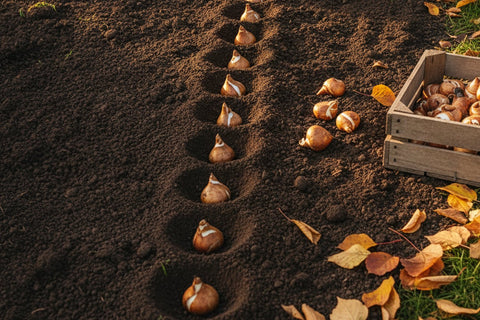
Soil temperature is a better cue than the calendar, the same cue the fall bulbs use: once the soil at planting depth drops below about sixty degrees Fahrenheit, the window is open. Peony roots grow at temperatures far too cold for leaves, which is why a root planted in October is anchored by December without showing above ground.
| Region | Typical planting window |
|---|---|
| Zones 3 to 5 (northern states, upper Midwest, mountain West) | Mid September to mid October |
| Zones 6 to 7 (Mid-Atlantic, Ohio Valley, lower Midwest) | October to mid November |
| Zone 8 (upper South, warmer Pacific Northwest) | Late October to November, crown set shallow |
| Zone 9 and warmer | Low chill or Itoh types only, November or December |
Peonies are hardy in zones 3 to 8, and the limit at the warm end is chill rather than heat: the buds need a long cold rest to open. In zone 9 the herbaceous peony is a gamble and Itoh hybrids are the honest answer.
Late still beats never: a root planted in late November in zone 6 roots through a mild December and usually comes up on schedule. Peonies bought potted in spring still answer to the depth rule below, which often means setting the plant higher than the nursery did.
Where to plant peonies
Six hours of direct sun or more. In the South, morning sun with afternoon shade works well and keeps the flowers from bleaching. Less than a half day gives you leaves and few flowers.

Drainage matters as much as sun. The crown sits just under the surface and rots in soil that stays saturated, so anywhere that puddles after rain is out. Heavy clay works if you plant shallow and mix compost through the backfill; our guide to improving clay soil covers the longer fix.
Space plants three feet apart, crown to crown, keep them four to five feet from shrubs, and stay out from under trees. A mature peony is a three foot dome with a matching root mass, and it loses to tree roots for water every time. Air moving through the clump keeps the foliage dry, the cheapest defense against the gray mold that blackens buds in a wet spring. Choose the spot once, because a move costs a season or two.
How deep to plant peonies
The eyes, the pink or white growth buds on the crown where the stems come from, go one to two inches below the finished soil surface. Two inches in zones 3 to 6, one inch or barely covered in zones 7 and 8. Measure to the top of the eyes, not the bottom of the roots.

This is the whole game. Planted too deep, a peony grows well and rarely flowers, because the buds sit too far down to get the winter chill they need to set. It is the most common reason a peony looks fine and does nothing, and the easiest to fix: lift it in fall and reset it higher.
Do not carry the bulb math over. Fall bulbs go in at about three times the height of the bulb, but a peony is a tuberous root with the growth buds right at the top, and burying them is the mistake. Our planting depth guide has the numbers for peonies, daffodils, tulips, garlic and the rest on one page.
Everything above applies to herbaceous and Itoh peonies, which follow the same one to two inch rule. Tree peonies do not: they are grafted, and the graft union goes four to six inches down so the top can root out on its own.
How to plant a bare root peony
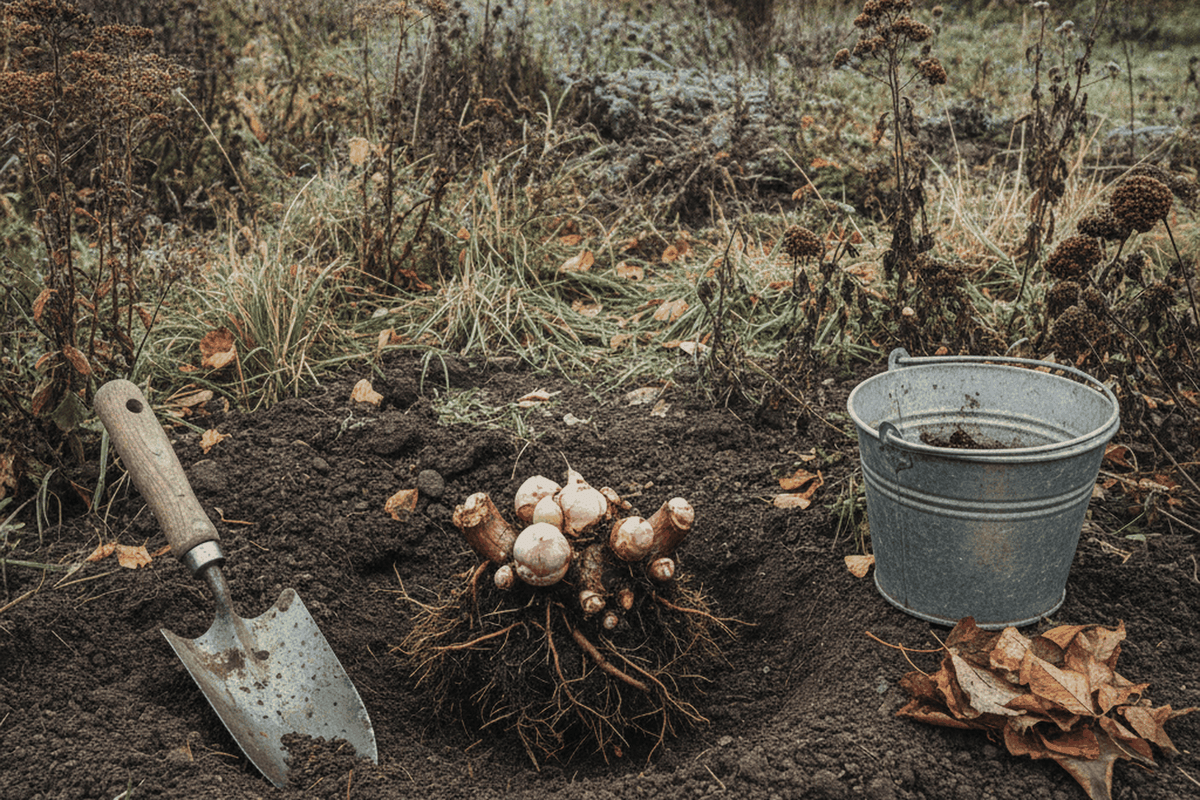
A bare root peony arrives looking like a bundle of brown carrots with a few pink buds on top. Soak it for an hour if it looks dry, then plant it.
1. Dig a wide hole
Twelve to eighteen inches across and about as deep. Wide matters more than deep, because the roots run sideways in year one. A Spear Head Spade is the tool for it: the pointed, sharpened blade cuts down through sod and old roots rather than bouncing off them, and the 40 inch D-handle gives you the leverage to open a hole that size with up to 80% less effort than a standard shovel. In tight beds the 30 inch Mini does the same job in less room.
2. Loosen the bottom and mix the backfill
Chop the floor of the hole a few inches deeper, then mix a few shovels of compost into the soil you took out. Work a light dose of low nitrogen fertilizer into that backfill, not into the bottom where the roots will sit against it. Skip the traditional handful of bone meal, which supplies little beyond phosphorus and brings dogs, skunks and raccoons to dig where you planted.
3. Set the crown at the right height
Backfill most of the way, firm it, and build a low mound in the middle. Set it on the mound with the roots spread down and out and the eyes facing up. Check the depth before you cover anything: lay the spade handle across the hole and measure down to the eyes. If you are between numbers, set it a touch shallow.
4. Backfill and firm
Fill in around the roots in stages, pressing gently by hand so no air pockets are left under the crown, and do not stamp it down. This part is done on your knees, and a kneeler makes them comfortable ones.
5. Water once, thoroughly
One deep soaking to settle the soil and start the roots. After that, water only if the fall stays dry, since peonies do not want wet feet in winter.
6. Mulch the first winter, then take it off
New plantings can heave out in the first freeze and thaw cycle, so once the ground has cooled, lay two to three inches of loose straw or shredded leaves over the crown. A bagged garden straw such as GardenStraw spreads thin and rakes off easily. Pull it off as the shoots appear in spring, because mulch left sitting on a crown acts like planting it deeper.
Feeding and watering
Peonies are light feeders. Too much nitrogen gives tall, floppy, leafy growth and no buds, so keep lawn fertilizer away from the clump.
Give a small amount of a low nitrogen, phosphorus forward blend twice a year: as the red shoots break ground in spring, and again right after the flowers finish, while the plant is building next year's buds. A 3-5-3 blend such as Espoma Bulb-tone suits it, scratched into a ring a foot out from the crown rather than piled against it.
Water deeply once a week in dry weather through the first summer. After that a peony is close to drought tolerant, though a dry August means fewer buds the following spring. Water at the base, not overhead: wet foliage and still air are what gray mold wants, and cutting the foliage to the ground in fall breaks that cycle.
Supporting the flowers
Single and semi double peonies usually hold themselves up. The big doubles catch rain in the flower and go face down in the first storm, so the support goes on before it happens.
Set a grow through grid or a peony ring over the crown in early spring, before the shoots reach eight to ten inches, and let the stems come up through it. A Luster Leaf grow through grid sits on legs you push into the ground, so you can lift it higher as the stems grow, and it disappears once the foliage fills in. Dropped over a plant already in bud, a grid means bending stems to fit and snapping a few.
Why will my peony not bloom?
A peony that grows well and will not flower is the most common complaint, and the list of causes is short.
Planted too deep. The most likely answer. Scrape the soil back in fall and find the eyes. More than two inches down, lift the plant and reset it with the eyes one to two inches under the surface. It usually flowers again within a year or two.
Too young. A bare root division needs two to three years to build enough root to carry a full display. One or two stems and no bud in year one is normal, a few flowers in year two, the full display in year three.
Not enough sun. Under six hours and bud count falls off. A peony that flowered for ten years and stopped has often been shaded out by a tree that grew over it.
Too much nitrogen. Lawn fertilizer drifting into the bed produces the lush green peony with no flowers. Stop feeding it and it recovers in a season or two.
Moved or divided recently. Any lifted peony takes a year or two to settle, and divisions with one or two eyes take longer still.
Buds that formed and then failed. Small buds that turn brown or black are a different problem: either a late hard frost caught them or gray mold got in. Remove the affected stems and keep water off the leaves.
Transplanting and dividing peonies
Peonies do not need routine division. A clump can sit for decades and keep flowering, so divide only to move a plant or make more of one you like.
Fall is the time, September through October, after the foliage is cut back. Start a foot to eighteen inches outside the clump and cut straight down all the way around before you lever anything up, so the spade never runs through the crown. Lift the root mass out, then hose the soil off so you can see the eyes.
Cut the crown into pieces with a sharp knife, three to five eyes and a good handful of storage root on each. Smaller divisions grow but take an extra year or two to flower. Replant the same day at the same one to two inch depth. Our guide to dividing perennials covers the general method, and transplanting shrubs and perennials covers moving a whole clump while the soil is warm.
Ants on peony buds
Ants on the buds are harmless and no reason to spray. They come for the nectar the buds secrete on the sepals and leave when the flowers open. Shake the stems before cutting flowers for the house.
Tools for this job
What the wide hole, the depth check and the first winter actually call for, in the order you will reach for them.

Spear Head Spade 40 inch D-Handle Garden Spade
Opens the twelve to eighteen inch wide hole a peony wants, and cuts a mature clump out from a foot outside the crown when you divide it.
Luster Leaf 24 by 18 inch grow through grid
Goes over the crown in early spring on legs you push into the ground, so the big double flowers come up through it instead of going face down after a storm.
Check price on AmazonEspoma Organic Bulb-tone 3-5-3
A low nitrogen, phosphorus forward blend for the backfill and the two light feeds a peony wants, instead of a lawn fertilizer that gives you leaves and no buds.
Check price on AmazonHealthiStraw GardenStraw mulch, 3 cubic feet
Loose straw for the first winter only, spread thin over a new crown against frost heave and easy to rake back off in early spring.
Check price on Amazon
Spear Head Spade Garden Kneeler
Setting a crown to within an inch and firming soil around the roots by hand is all done on your knees.
Common questions
When should you plant peonies?
Plant bare root peonies in fall, September through October in most regions, about six weeks before the ground freezes hard. That gives the roots time to establish in cool soil while the plant is dormant. Potted peonies can go in any time the ground is workable, though fall still gives the best first season.
How deep do you plant peonies?
Set the eyes, the growth buds on top of the crown, one to two inches below the finished soil surface. Use two inches in zones 3 to 6 and one inch or less in zones 7 and 8. Deeper than two inches is the most common reason a peony grows well and never flowers.
Why are my peonies not blooming?
In order of likelihood: the crown is planted too deep, the plant is younger than three years, it gets less than six hours of sun, it is getting too much nitrogen from a lawn or general fertilizer, or it was moved or divided in the last year or two. Check the depth of the eyes first.
Can you plant peonies in spring?
You can, and potted peonies are sold for exactly that, but a bare root peony planted in spring starts behind. It has to make roots and leaves at the same time in warming soil, so expect a weak first season and little or no flower. Fall planting is worth the wait.
Do peonies need full sun?
Yes, six hours or more of direct sun for a full set of buds. Morning sun with afternoon shade works well in hot southern gardens and keeps the flowers from bleaching. Deep shade, or a spot competing with tree roots for water, gives you a healthy green plant and very few flowers.
The bottom line
Plant bare root peonies in fall, six weeks before the ground freezes hard, in a spot with six hours of sun and drainage you trust. Dig twelve to eighteen inches wide, set the eyes one to two inches under the surface, space them three feet apart, water once and mulch only the first winter. Then leave the plant alone.
Our guides to planting daffodil bulbs and to which bulbs go in this fall cover the spring flowers that finish before the peonies open.
Disclosure: some links in this guide are affiliate links to Amazon. This is at no extra cost to you, and it never changes our honest, use-based recommendations.