As an Amazon Associate we earn from qualifying purchases. Some brands also pay us when you click or buy, so those links are ads. Full disclosure below
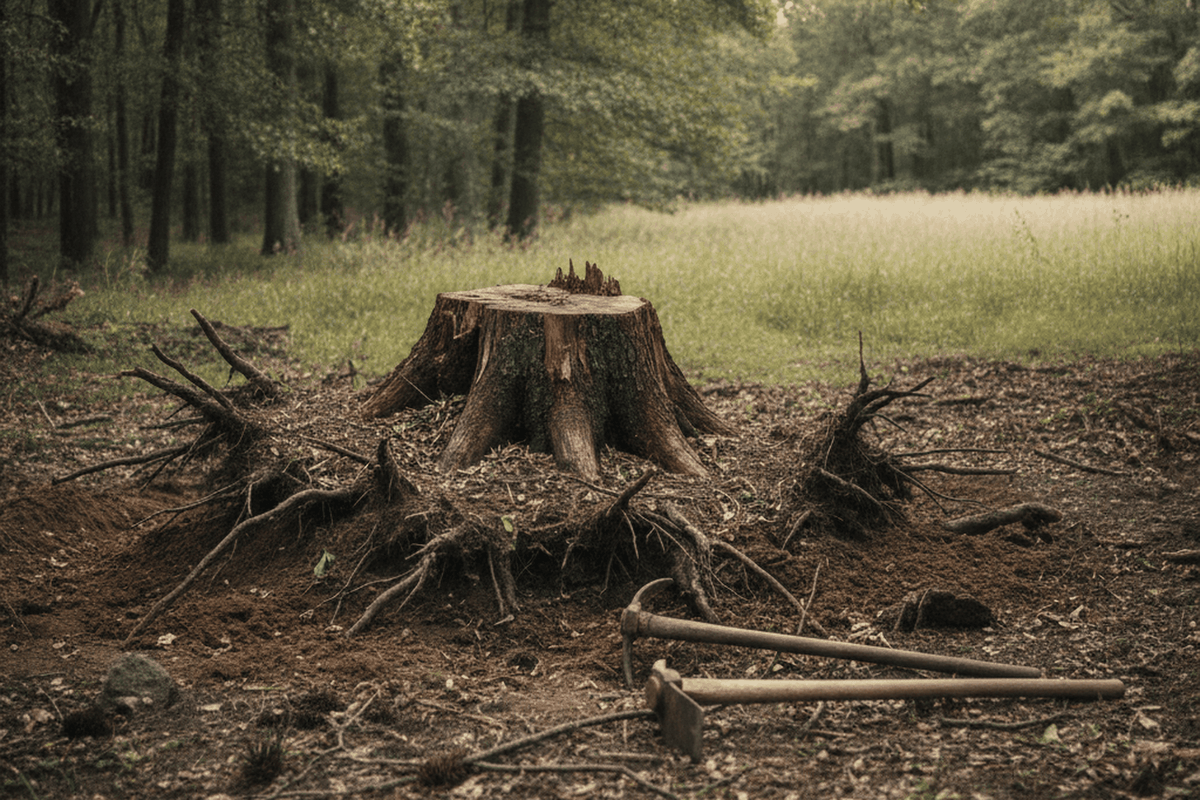
To remove a tree stump by hand, dig a ring two to three feet across around it, expose the lateral roots, cut each one, then lever the stump up and cut the taproot underneath it. Plan on an afternoon for a stump under about eight inches across. Anything bigger is grinder work.
Stump removal gets sold as a machine job, and for a big stump it is. But most stumps in a home yard are small: an overgrown shrub, a volunteer maple, a fruit tree that finally gave up. What separates a two hour job from a wasted weekend is order of operations, so cut the roots first and lift second, never the reverse. If you have never sawed a root under load, read our guide to cutting through roots when digging first.
Start by sizing the job
How to remove a stump comes down to one number: the diameter of the cut face, not the flare at the base. That measurement decides whether you dig or rent.
| Stump diameter | Realistic method | Why |
|---|---|---|
| Under 6 inches | Dig and cut by hand | Loppers handle the roots, and it lifts in an hour |
| 6 to 8 inches | Dig and cut, full afternoon | Woody laterals, so you want a root saw and a bar |
| 8 to 14 inches | Rented stump grinder | Digging becomes a weekend of sawing in a hole |
| Over 14 inches, or tight to a wall or utility | Hire it out | Big anchor roots and no room to work safely |
Age matters almost as much as diameter, and species decides where the roots are: maple, birch and ash spread laterals near the surface, while oak, hickory and walnut drive a taproot straight down.
Before the first swing, call 811 and have your utilities marked. It is free, it takes a few business days, and gas, cable and irrigation lines run shallower than people expect. Then put on eye protection and gloves.
Check what else is rooted nearby. If a living tree stands within a few feet, keep your ring tight and leave its thick roots alone. A common arborist rule of thumb is to stay outside roughly three to five times its trunk diameter before cutting anything significant. The trunk and limbs above the stump are chainsaw, splitter and chipper work, covered in our guides to the best chainsaws, best log splitters and best wood chippers. Limbs out of reach from the ground are pole saw work, and our best pole saws guide picks one by job.
How to remove a tree stump by hand, step by step
1. Clear a ring two to three feet across
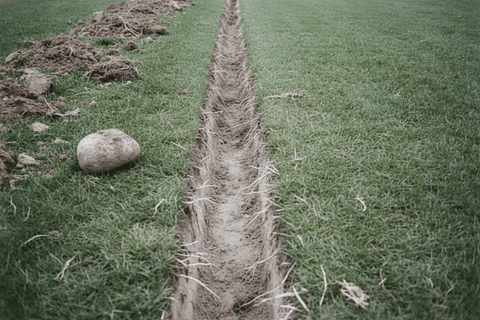
Strip the sod, mulch and loose soil from a ring around the stump, about two feet across for a small one and three for anything near eight inches. Pile it on a tarp so you are not shoveling the same dirt twice. Work the ring down eight to ten inches. You want a clean trench with the stump in the middle, so every cut from here on has room around your hands.
2. Expose the lateral roots
Alternate a cutter mattock and a spade. The adze side of the mattock pulls compacted soil off the root tops, and the spade trenches the ring and skims soil off the sides of each root. You are not cutting yet, you are uncovering: follow each root out until you can see how thick it is and which way it runs. A grub hoe chops and clears the same ground, though it stops short of a mattock once the roots pass an inch.

Swing the mattock across your body, never toward your feet, and stand wide enough that a miss buries itself in soil. Do not swing at a root you cannot see clearly, or at one lying on a rock.
3. Cut every root you uncover
Match the tool to the root. Under about an inch cuts on the downstroke of a sharp spade while you keep digging, one to three inches is loppers or a root saw, and anything thicker is saw work. Undercut first, scraping soil from beneath the root so it has open air below, because a root packed in dirt just flexes and absorbs your force. Cut each root twice, close to the stump and out at the edge of your ring, and lift the section away.
4. Dig under the stump and find the taproot
With the laterals cut all the way around, reach under the stump from the trench and dig inward until your hand or your bar meets whatever is still holding it. On a shallow-rooted species that is often no more than a mat of fine roots; on an oak or a walnut it is a solid central root under the middle. Undercut from two or three sides, since packed mud holds a stump nearly as well as wood.
5. Rock the stump and lever it with a digging bar
Push the stump hard, side to side and front to back. If it rocks freely, the taproot is the last connection. If it barely gives, there is a lateral you missed, so follow the tight side back out and find it.
Then pry with a digging bar under the edge, using a block of wood as a fulcrum so the bar lifts instead of sinking. Stand to the side of the bar, never over it, and keep your hands and feet out from under the bar and the stump. Move around the stump instead of working one side, keep your back straight, and drive with your legs. Stop the moment the bar binds on something solid, because that is a root telling you to go cut it.
6. Cut the taproot and lift the stump out
Lever the stump up and prop the gap open with a block of wood or the bar, then saw the taproot with both hands on the saw and nothing of yours under the stump. Take short strokes and keep your face out of the arc of the blade. Once it is free, roll the stump out of the hole rather than lifting it, because a wet stump weighs far more than it looks.
7. Fill the hole and let it settle
Break up the sides and bottom with the mattock so water can move out instead of pooling in a clay bowl. Backfill with native soil in six inch layers, tamping and watering each one to collapse air pockets. Mound the surface an inch or two above grade, because it will sink, then top it up after a couple of rains and seed or sod.
Where a Spear Head Spade actually helps
A spade does two of the seven steps above better than a round-point shovel: it trenches the ring, and it slices small roots on the downstroke without a tool change, which covers most of what you meet in the first foot of soil. That second job is what the 40 inch D-Handle Spear Head Spade is built for. The blade enters at a single point and slices outward as it sinks, sharpened tip to tail, so it draws an edge through a finger-thick root instead of chopping at it with a flat front edge. The double-patented profile also lets it wedge around rocks rather than stopping dead on them, which matters in the rubble packed against an old root plate. Step onto the foot rest and let your weight drive the cut. It is the first hybrid spade and shovel, and digging with it takes up to 80% less effort than a standard shovel.
The honest limit: a spade is not a saw or a pry bar. Once a root is woody and thicker than about an inch, switch to loppers or the root saw, and never lever a blade against a root pinned by a rock. For how the shapes compare, see our roundup of the best shovels for digging.
When a stump grinder rental makes more sense
A stump grinder is a wheel of carbide teeth that chews the stump down to somewhere between four and twelve inches below grade. Walk-behind units rent by the half day or the day at most equipment yards, and the rental line is not the whole cost: you also need a way to tow it, and a deposit. Call the yard for current rates and price a professional at the same time, since for one small stump the two often land close.
Know what grinding leaves: a crater of chips and sawdust, and every lateral root still in the ground. Chips are not soil, so if you plan to plant or sod there, scoop most out and backfill.
Grinding wins on stumps over about eight inches, on several in one day, in ground too rocky to trench, and when the surface has to be clear for a lawn or patio. It is the wrong tool against a foundation, a wall or a marked utility, and it is serious equipment: eye and ear protection, sturdy boots, no bystanders in the debris arc, and a sweep for rocks and wire first. When the grinding is done, scoop out the chips and backfill, and if that patch sinks below the lawn later, our guide to leveling a yard by hand covers topping it up.
Chemical and slow methods, honestly
None of these remove a stump. They soften it so you can break it apart later with an axe or mattock, and all are measured in months. A punky stump is hard on a good edge, so keep the felling tools away from it, and our splitting axe picks cover the heads worth owning for the clean wood instead.
Potassium nitrate stump remover is the fastest of the slow options. Drill a grid of deep holes in the top and a few angled in from the side, pack the granules in, and add water. The nitrogen feeds the fungi already breaking the wood down. Expect six to twelve months on softwood and longer on hardwood. Keep it away from children, pets and food beds, and follow the label.
Epsom salt stump removal is the same idea, slower and weaker. Magnesium sulfate pulls moisture out of the wood, so a treated stump dries and turns punky over a year or more. Cheap and easy is the whole case for it, and repeated heavy salting loads the soil with magnesium.
Do not burn a stump. Many places prohibit open burning of this kind, and for a physical reason: stump fires travel along roots underground, smolder for days, and surface where nobody is watching. The trunk and limbs you cut off before you got to the stump are a different story, since that is a season of firewood once it is split and stacked up off wet ground, and our firewood rack picks cover the frames that keep it dry. Check your local fire authority rules first.
The free method is patience. Cut the stump flush, drill holes in the top to hold water, cover it with mulch and keep it damp. Softwood breaks down in three to five years that way, and hardwood takes longer.
Leave it, or plant around it
Removal is not automatically the right answer. Cut flush to the ground and mowed over, a stump stops being an obstacle right away and costs nothing, though the wood takes years to rot.
In a bed rather than a lawn it can earn its place: hollow the softening center for a planter, stand a container on it, or build a raised bed around it.
The one case where you should not leave it is replanting in the same spot. Decaying wood ties up soil nitrogen, settles unevenly under a young root ball, and some stumps host honey fungus, which can move into the new tree. Take the stump and major roots out first, or shift the new hole several feet aside. Our guide on how to plant a tree covers width, depth and backfill.
Tools for this job
Five tools cover the whole job, from trenching the ring to levering the stump out of the hole.

Spear Head Spade 40 inch D-Handle Garden Spade
Trenches the ring around the stump and slices every root under about an inch on the downstroke, so you are not swapping tools for the small stuff.
Truper 5 lb Cutter Mattock, 36 inch fiberglass handle
The adze side breaks compacted soil off the root tops and the cutting side gets through woody laterals, so it does the heavy uncovering.
Check price on AmazonA saw you can push into gritty soil without crying over the teeth, for the one to three inch roots and the taproot cut under the stump.
Check price on AmazonTruper 49 inch Digging Bar, chisel and pointed ends
The leverage that pops a cut stump out of the hole, and the point breaks up rock and hardpan that a spade skates off.
Check price on AmazonFiskars 32 inch PowerGear2 Bypass Loppers
Faster than a saw on the one to two inch roots, and the long handles reach into the trench without you kneeling in it.
Check price on AmazonCommon questions
How long does it take to remove a tree stump by hand?
For a stump under about six inches across, plan on one to two hours once you are set up. Six to eight inches is usually a long afternoon. Age matters as much as size, since a stump cut several years ago has softer, more brittle roots than one cut last month.
Can you plant over a removed stump?
Yes, once the hole is filled and settled. Grass and shallow annuals go in right away. For a new tree or shrub in the same spot, remove the big roots and any buried wood first, since decaying wood ties up nitrogen and settles unevenly under a young root ball.
How deep are tree stump roots?
Most of a tree root system sits in the top twelve to eighteen inches of soil and spreads well past the branch tips. Only some species send a true taproot deeper, and even then it is often a foot or two on a small tree. Depth is rarely the hard part. Spread is.
Does Epsom salt really kill a stump?
It can dry one out over a long period, but it is slow and unreliable. Epsom salt pulls moisture from the wood, so a treated stump may take a year or more to turn punky. A potassium nitrate stump remover works faster, and neither product dissolves the stump for you.
What do you do with the hole after removing a stump?
Break up the sides so water can drain out, then backfill with native soil rather than pure compost, tamping in layers as you go. Water it in to collapse air pockets, mound the surface an inch or two proud, and expect to top it up once more after a few rains.
Bottom line
Under about eight inches, dig it out: clear the ring, cut the laterals, undercut the taproot, lever it free and backfill in layers. Over eight inches, rent a grinder or hire it out.
Disclosure: some links in this guide are affiliate links to Amazon. This is at no extra cost to you, and it never changes our honest, use-based recommendations.
Product prices and availability are accurate as of the date/time indicated and are subject to change. Any price and availability information displayed on Amazon.com at the time of purchase will apply to the purchase of this product.